
Buying Guide
Full Metal Platform Bed Frame: Fit Math for Kids’ Rooms
Oct
Full Metal Platform Bed Frame: Fit Math for Kids’ Rooms
A full metal platform bed frame is a steel bed base for a 54-by-75-inch full mattress, with slats or a grid that supports the mattress directly at platform height, so no box spring is needed. That one definition hides a fork in the road, because “full metal platform bed frame” is typed by two different shoppers: the parent who needs a full-size frame in a child’s or teenager’s room, and the parent who wants a frame built entirely of metal rather than metal-and-wood. Both groups read the same listings, and both get caught by the same four numbers.
This guide works through those numbers using published specifications only: four full-size metal frames sold by large US retailers, and four frames from our own catalogue. Where a listing does not publish a figure, this page says so instead of filling the gap.
Two meanings of “full metal” in a product title
Retailers use the phrase loosely, and the ambiguity is not cosmetic. On Target and Walmart listings, a “Full Metal Bed Frame” title is usually a promise about mattress size, not about construction, and the listing often does not settle which it means: one Target frame titled “Full Metal Bed Frame, 14 in. High” is sold as a full-size frame with an overall width of 56 inches, wider than the 54-inch mattress it holds. On manufacturer pages, “full metal” more often describes all-steel construction, the opposite of a metal frame with wooden slats or a wooden headboard. A single title can carry both readings and give you no way to tell them apart.
The fix takes ten seconds: read the material line, not the title. If it says steel, iron, or a gauge number, you are looking at an all-metal frame. If it says Metal + Wood, MDF, or plywood, some part of the structure is timber, and you should ask the seller which part before assuming the whole thing is steel. Our own queen metal platform bed frame with trundle lists its material as Metal + Wood, so treat it as a hybrid frame, not an all-steel one.
The four numbers that decide whether a full frame fits
Every full-size platform frame on the market is described with the same four figures, and only one of them is the mattress size. The table below is pulled from four current US listings, and the spread is wider than most shoppers expect.
| Full-size metal frame | Overall size (L × W × H) | Published slat spacing | Under-bed clearance | Rated load |
|---|---|---|---|---|
| Yaheetech full metal platform | 75.5 × 54 × 14.5 in | 6.1 in | 12.6 in | 800 lb |
| Zinus Joseph, full | 74.5 × 53.5 × 14 in | 3.07–3.43 in | 11.8 in | 500 lb |
| Target 14-inch full platform | 77.56 × 56 × 13.9 in | Not published | Not published | 800 lb |
| Costway full metal frame | 80.5 × 56 × 38.5 in | Not published | 13.5 in | 660 lb |
1. Overall size is not the mattress size. A standard full mattress measures 54 by 75 inches, yet these frames run from 74.5 to 80.5 inches long and 53.5 to 56 inches wide. The Costway frame is 5.5 inches longer than the mattress it holds, because the headboard and footboard are part of the overall figure. Measure the wall you have, then treat the frame’s overall length as the number that has to fit.
2. Slat spacing varies by nearly double. The Zinus Joseph lists slats 3.07 to 3.43 inches apart; the Yaheetech lists 6.1 inches. Both are sold as full metal platform frames. If your mattress maker requires a maximum gap (many foam and latex warranties do), this is the number to check, and it is the one most listings omit entirely.
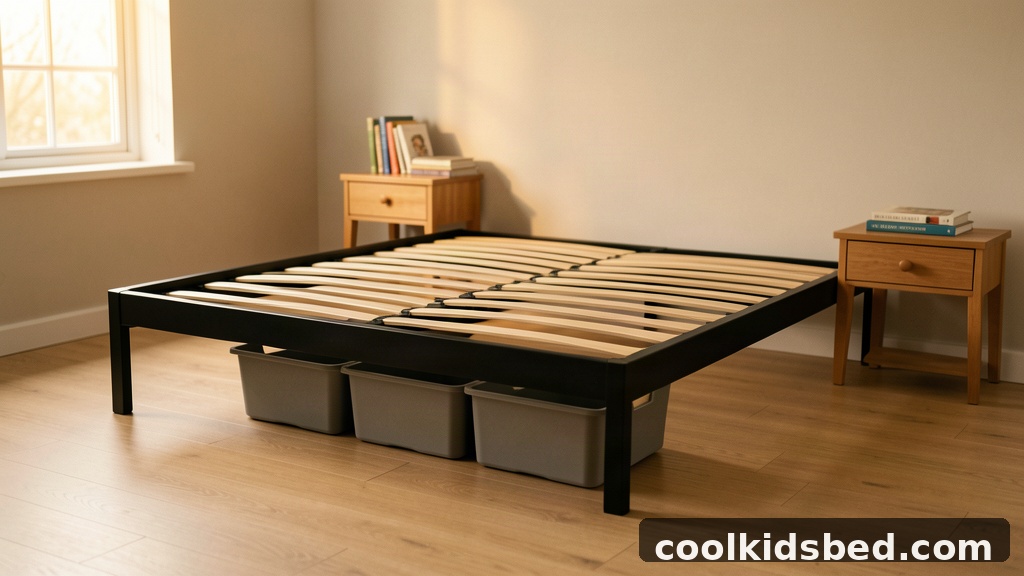
3. Clearance decides what goes underneath. Published clearance ranges from 11.8 to 13.5 inches on these frames. That is enough for flat storage bins and a vacuum head, and not enough for a deep drawer unit. On frames with a headboard, the height figure at the end of the spec line usually measures to the top of the headboard, not the deck, so do not read it as clearance.
4. Rated load is model-specific. These four frames are rated for 500, 660, 800, and 800 lb. None of them publishes whether the rating covers the mattress, the sleepers, or both, so treat it as a ceiling set by the seller rather than a guaranteed working load.
Full versus queen, measured on real frames
The full-versus-queen decision is usually made on the mattress, but the frame is what has to fit the room. Here is how our own catalogue measures up, including the one raised metal frame we sell for a full mattress.
| Model (ours) | Size | Overall size (L × W × H) | Rated load | Mattress guidance |
|---|---|---|---|---|
| Queen metal platform bed frame with trundle, USB ports and slat support | Queen | 86.2 × 61.8 × 39 in | Bed 400 lb; trundle 350 lb | 6–8 in on the bed, 4–6 in on the trundle |
| Metal full size loft bed with stairs, high guardrails and beside storage shelf | Full | 94.3 × 56 × 74 in | Upper bed 500 lb | 6 in maximum |
| Platform full size bed with storage shelf, guardrail, slide and ladder | Full | 85.3 × 87.4 × 34.1 in | 550 lb | 6–8 in |
The queen frame is 7.8 inches wider than a full frame (61.8 against 54 inches), and its 86.2-inch overall length includes the headboard and footboard, so it is not comparable to a bare 75-inch mattress length. In a child’s room, that width difference is the number that decides whether a nightstand still fits beside the bed. The loft frame goes the other way: it is 56 inches wide and only 94.3 inches long, but it is 74 inches tall and leaves 54 inches of clear space underneath, which is the whole point of buying it.
Our queen metal frame also carries 13 bed slats and 16 trundle slats, and the trundle requires a 4-to-6-inch mattress. That thin-mattress requirement is a real constraint, not a suggestion: a standard 10-inch mattress will not clear the bed above it when the trundle is pushed in.
Metal versus wood at the same footprint
If the room already fits a full-size frame, the material choice comes down to weight, noise, and finish. Our retro style full size wood platform bed frame is rated to 400 lb on 10 slats with a 10-inch mattress recommendation, and it is built from MDF, plywood, and pine. The metal queen frame above is listed at an overall product weight of 95.95 lb, carries a 400 lb bed rating and a 350 lb trundle rating, and uses a denser slat count.
Neither material wins outright. Metal holds a higher slat count in a thinner profile and resists warping in a humid room; timber absorbs sound better and does not transmit a squeak through a bolted joint the way steel tubing can. What matters more is the joint design, which is why the noise section below is worth reading before either purchase.
Assembly, noise, and the mistakes owners report
Owner complaints on full metal platform frames cluster tightly, and all three are fixable before the first night rather than after.
- The mattress slides on smooth metal slats. This is the most repeated complaint, especially on frames with no retaining lip. A non-slip mattress pad or a sheet of rubber shelf liner solves it; a frame with stoppers solves it permanently.
- The frame is not as snug as the mattress. Reviewers report frames that feel too small, and slats that are too short to seat in their brackets on click-in designs. Measure the mattress and compare it with the frame’s assembled dimensions before you assemble, not after.
- Squeaks develop at the joints. Creaking at bolted connections and loosened hardware show up after a few months. Retighten fasteners after the first week, then again after a season, and put felt or foam at metal-to-metal contact points.
Powder-coated finishes and non-slip floor pads are common on metal frames, and both are listed features rather than guarantees. A coating protects the surface; it does not establish a corrosion test result. For children’s furniture, finishes fall under the lead-in-paint limit in 16 CFR Part 1303, so ask a seller for the test report rather than accepting “non-toxic” as a description.
When a raised metal frame is the better buy
If the reason you are shopping is floor space rather than a new mattress, a platform frame will not solve it. The four full-size frames in the table above sit 13.9 to 14.5 inches tall at the deck, with 11.8 to 13.5 inches of published clearance underneath: enough for flat bins and a vacuum head, not enough to stand a desk under. A full-size metal loft does give you that floor back, and it is a different purchase with a different rulebook. Our metal full size loft bed with stairs and high guardrails puts the deck 54 inches up on a 500 lb rated platform, which is enough headroom for a desk underneath.
A raised sleep platform sold for children falls under the federal bunk bed rule, 16 CFR Part 1513, which governs guardrails, mattress support, and the gaps that stop a child slipping through. The current text is published at 16 CFR Part 1513 on eCFR; whether a specific loft is in scope is a question for the seller’s compliance paperwork. If that is the direction you are heading, our full size loft bed with stairs guide covers the staircase footprint math in detail.
Full Metal Platform Bed Frame collections worth comparing
These collections are grouped the way buyers actually narrow down this choice, so the specs you need are one click apart.
- full size platform bed frame
- full size platform bed with drawers
- full size platform bed with trundle
- full size platform bed
- Full Size Bed collection
- Platform Bed collection
FAQ
What size mattress fits a full metal platform bed frame?
A standard full mattress is 54 by 75 inches, and a full platform frame is built around that footprint. The frame’s overall dimensions will be larger, often 74.5 to 80.5 inches long once headboard and footboard are included. Measure the frame’s interior opening, not its overall length, before you assume a mattress will drop in.
Do full metal platform bed frames need a box spring?
No. A platform frame uses slats or a metal grid to hold the mattress directly, which is why it sits lower than a traditional rail-and-box-spring setup. Check the slat spacing against your mattress maker’s requirement, because a wide gap can void a foam mattress warranty even though the frame is doing its job.
How much weight will a full metal platform frame hold?
Published ratings on current full-size models run from 500 lb to 800 lb. Our own queen metal platform frame is rated at 400 lb for the bed and 350 lb for its trundle, with 13 and 16 slats respectively. Ratings are set by each seller and rarely say whether the mattress counts toward the total.
How far apart should platform bed slats be?
It depends on the frame, and the range is wide: 3.07 to 3.43 inches on one Zinus full frame, 6.1 inches on a Yaheetech full frame. Tighter spacing supports a foam mattress better. If the listing publishes no spacing figure, ask the seller before buying rather than assuming a standard.
Why does my metal bed frame squeak?
Most squeaks come from bolted joints that loosened after assembly, or from metal parts rubbing where they meet. Retighten every fastener after the first week of use, add felt or foam at metal-to-metal contact points, and use grippy foot pads on hard floors. A sliding mattress can also sound like a squeak, so rule that out first.
{“@context”:”https://schema.org”,”@type”:”FAQPage”,”mainEntity”:[{“@type”:”Question”,”name”:”What size mattress fits a full metal platform bed frame?”,”acceptedAnswer”:{“@type”:”Answer”,”text”:”A standard full mattress is 54 by 75 inches, and a full platform frame is built around that footprint. The frame’s overall dimensions will be larger, often 74.5 to 80.5 inches long once headboard and footboard are included. Measure the frame’s interior opening, not its overall length, before you assume a mattress will drop in.”}},{“@type”:”Question”,”name”:”Do full metal platform bed frames need a box spring?”,”acceptedAnswer”:{“@type”:”Answer”,”text”:”No. A platform frame uses slats or a metal grid to hold the mattress directly, which is why it sits lower than a traditional rail-and-box-spring setup. Check the slat spacing against your mattress maker’s requirement, because a wide gap can void a foam mattress warranty even though the frame is doing its job.”}},{“@type”:”Question”,”name”:”How much weight will a full metal platform frame hold?”,”acceptedAnswer”:{“@type”:”Answer”,”text”:”Published ratings on current full-size models run from 500 lb to 800 lb. Our own queen metal platform frame is rated at 400 lb for the bed and 350 lb for its trundle, with 13 and 16 slats respectively. Ratings are set by each seller and rarely say whether the mattress counts toward the total.”}},{“@type”:”Question”,”name”:”How far apart should platform bed slats be?”,”acceptedAnswer”:{“@type”:”Answer”,”text”:”It depends on the frame, and the range is wide: 3.07 to 3.43 inches on one Zinus full frame, 6.1 inches on a Yaheetech full frame. Tighter spacing supports a foam mattress better. If the listing publishes no spacing figure, ask the seller before buying rather than assuming a standard.”}},{“@type”:”Question”,”name”:”Why does my metal bed frame squeak?”,”acceptedAnswer”:{“@type”:”Answer”,”text”:”Most squeaks come from bolted joints that loosened after assembly, or from metal parts rubbing where they meet. Retighten every fastener after the first week of use, add felt or foam at metal-to-metal contact points, and use grippy foot pads on hard floors. A sliding mattress can also sound like a squeak, so rule that out first.”}}]}Bottom line
A full metal platform bed frame is a simple purchase once you read the spec line instead of the title: confirm whether “full” means full-size or all-metal, compare the frame’s overall dimensions against your wall, check slat spacing against your mattress, and match the mattress thickness to the frame’s guidance. In a child’s or teenager’s room, the width difference between full and queen is usually the deciding measurement, not the length.
If you have settled on metal, start with our metal bed collection and compare the published load ratings and slat counts on each listing. If you are still open on material and want the widest choice of storage and trundle configurations, the platform bed category holds all of them in one place.
Frames worth comparing from other makers, if you want a second reference point on spacing and capacity:
- Linenspa full-size metal platform bed frame – 14-inch height, steel slats, no box spring required.
- Fluest full bed frame with all-metal slat support – upholstered headboard version of the same platform layout.