
Buying Guide
Twin Over Full Bunk Bed: Sizing, Safety and Fit
Nov
Twin Over Full Bunk Bed: Sizing, Safety and Fit
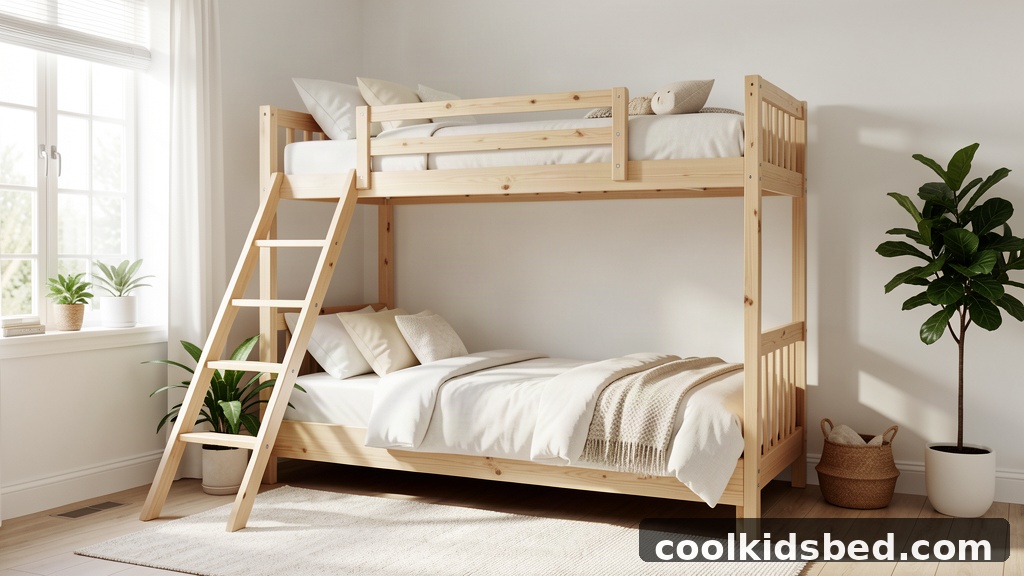
A twin over full bunk bed stacks an upper twin mattress (38 by 75 in) above a lower full mattress (54 by 75 in), so the bottom bunk is 16 in wider than the top. That extra width is why the layout suits a shared room with siblings of different sizes or a parent who lies down at bedtime.
Shopping for a twin over full bunk bed goes wrong in a predictable order. Buyers compare the two mattress sizes, order the frame that looks right in the photo, then discover at assembly that the footprint is longer than the wall, the top rail sits level with a thick mattress, or the ceiling leaves a child no room to sit up. Every one of those problems is measurable before you order.
Loft and bunk bed safety: what federal rules actually cover(federal citations checked against the official code · verified 2026-10-18)
The rulebook does not use the words twin over full. US bunk bed rules are written around a raised bed with a mattress platform above another sleeping surface, which is exactly what a bunk or a loft frame is. The rows below are the citations to read before assembly; the label on the left is our shorthand, not the legal text.
| Product rule | Citation | Source |
|---|---|---|
| Children’s bunk beds | 16 CFR Part 1513 | official text |
| Bunk beds (not for children) | 16 CFR Part 1213 | official text |
| Lead in paint and coatings | 16 CFR Part 1303 | official text |
| Clothing-storage tip-over | 16 CFR Part 1261 (STURDY Act) | official text |
Check these before the first night
- Bunk beds need guardrails on both sides of the upper bunk, plus a ladder – 16 CFR 1513 (children) and 1213 (other).
- Kids’ furniture finishes fall under the lead-in-paint limit in 16 CFR 1303; ask for the test report, not a slogan.
- A dresser in a kid’s room is a tip-over risk: 16 CFR 1261 (STURDY) is the rule to check, and anchoring is the practical fix.
Reference only, not legal advice. These are manufacturer/seller duties; read the current eCFR text before relying on it.
Why these citations matter for a bunk bed: the 16 CFR 1513 text is the baseline a US seller of children’s bunk beds has to build to – guardrail height, mattress support and the gap rules that stop a child from slipping through. Whether a specific frame is in scope is a question for the seller’s compliance paperwork, not for a product page photo.
This guide uses the published specifications of the four twin over full frames we stock, plus figures from current bunk bed listings and the federal rules that set guardrail height. The measurements below are the ones that decide whether the bed fits your room and your children.
Twin over full in inches, not in words
“Twin over full” names mattress sizes, not a frame size. The name tells you which mattresses go where and nothing about the footprint, the height or the load rating, all of which change from model to model.
A standard twin mattress measures 38 by 75 in (96.5 by 190.5 cm) and a full measures 54 by 75 in (137 by 190.5 cm). Both are the same length, so twin over full adds width to the lower bunk, not length.
- Sleeping capacity. Two children often share the full lower bunk while one sleeps above, which is why the layout works for three siblings in one room.
- Adult use. A full lower bunk is the same width as a standard double bed, so an adult can use it. The upper twin is the bunk that carries a child.
- Deck measurements vary. Our LED twin over full model lists decks at exactly 38 by 75 in and 54 by 75 in. The ladder and guardrail model lists 76 by 39.3 in above and 76 by 54.5 in below, which is slightly larger than the nominal mattress because the deck is sized to the frame opening.
That second point is the one buyers miss. A deck listed at 54.5 in for a 54 in mattress leaves about half an inch of margin, and a 76 in deck for a 75 in mattress leaves an inch. Read the deck figure in the specification table rather than assuming the mattress size is the opening size.
The four twin over full frames we stock, measured
These are the numbers from our own product listings, not a generic size chart. All four ship as twin over full, all four list a weight capacity per bunk, and they differ by more than a foot in overall length.
| Model | Overall L x W x H (in) | Upper / lower capacity | Mattress thickness guide | Frame weight | Access |
|---|---|---|---|---|---|
| Twin Over Full Bunk Bed with Ladder, Safety Guardrail (pine and MDF) | 78.7 x 55.9 x 62.3 | 300 / 350 lb | 6-8 in upper, 6-8 in lower | 138 lb | Side ladder; splits into two separate platform beds |
| Twin over Full Bunk Bed with LED Light Strip, Drawer and Ladder (wood and MDF) | 79.1 x 59.6 x 66.6 | 300 / 400 lb | 6-8 in upper, 6-8 in lower | 181.7 lb | Side ladder plus under-bed drawer |
| Twin over Full Bunk Bed with Shelf and LED (plywood, MDF and LVL) | 83.5 x 58.9 x 63 | 400 / 600 lb | 6 in upper, 6 in lower | 157.75 lb | Ladder plus 4-tier side bookshelf; 14 upper slats |
| Twin over Full Bunk Bed with Striped-Design Staircase and Side Shelves (plywood, pine and MDF) | 94.1 x 56.3 x 64 | 400 / 600 lb | 4-6 in upper, 6-8 in lower | 211 lb | Staircase with side shelving; ships in 3 packages |
Two rows deserve attention before you order. The staircase model is 94.1 in long and 211 lb: it needs nearly eight feet of wall and three packages, and it is the hardest of the group to carry upstairs. The ladder and guardrail model at 78.7 in is 15 in shorter, weighs 43 lb less, and converts into two freestanding platform beds if the room is later split.
Published listings from other sellers land in the same spread, which is the useful takeaway: a twin over full frame runs roughly 77.5 to 94.1 in long and 55.9 to 59.6 in wide. A Max & Lily model is listed at 81.5 by 59 by 65 in, a Costway metal frame at 77.5 by 59 by 71 in, and one Target model at 91.73 by 54.33 by 61.4 in. None of those numbers is derivable from the phrase “twin over full”.
Wall length and ceiling: the two measurements that fail
Length is where most rooms reject a bunk bed. Add the frame length to the access side: a staircase model needs clear floor at the end of the stairs, and a ladder model needs a gap beside the rail wide enough to climb. Then subtract doors, closets and radiators from the wall you were planning to use.
Ceiling height fails less often but worse, because it cannot be fixed with a different wall. Our four frames stand 61.3 to 66.6 in tall at the top rail, and the top mattress adds its own thickness on top of that. A 66.6 in frame with an 8 in mattress puts the sleeping surface at about 74.6 in, which under a standard 96 in ceiling leaves roughly 21 in of headroom above the top mattress.
That arithmetic is why a sloped ceiling, a ceiling fan, or a window above the head end can rule out the taller frame even when the floor plan works. Measure ceiling height at the wall where the bed will stand, not in the middle of the room, and remember that the child on the top bunk needs room to sit up.
Published heights in the same listings run from 61.4 in to 71 in, so if headroom is tight the shorter frames are the practical choice: our 62.3 in ladder model sits at the low end of the range.
Guardrail height, and the 5-inch rule behind it
The upper bunk is the part of a bunk bed that injures children, and guardrails are the part that prevents it. In the United States, children’s bunk beds fall under 16 CFR Part 1513, and the voluntary consumer safety specification for bunk beds is ASTM F1427.
Federal bunk bed guidance, as summarised in furniture safety guidance, calls for the guardrail to stand at least 5 in above the mattress surface, with a guardrail running along both sides of the upper bunk. A thick mattress eats that margin: an 11 in mattress in a rail sized for a 6 in mattress leaves 5 in less protection, which is exactly the failure owners describe in reviews.
Our listings publish the mattress thickness each bunk is built for, and the range across the four frames is 4 to 8 in. On the staircase model the upper bunk is rated for a 4-6 in mattress while the lower takes 6-8 in, which is a deliberate difference: the upper deck and its rails were sized for the thinner mattress.
Two more details decide whether the rail actually works. Slats support the mattress so it cannot sag below the rail line, and a full-length rail on the open long side matters more than a decorative end panel. The shelf and LED frame lists 14 slats on the upper bunk; the other three listings do not publish a slat count.
The Consumer Product Safety Commission publishes its own bunk bed guidance for manufacturers and importers, including the guardrail and entrapment requirements: CPSC bunk beds business guidance.
What a weight capacity actually covers
Stated capacities across our four frames run from 300 lb on an upper bunk to 600 lb on a lower one. Published listings elsewhere span a much wider range, from 200/250 lb on a budget model to 800 lb per bed on a premium one, so the number is a manufacturer claim about that assembly rather than a property of the size.
- Read it per bunk. Our ladder model rates the top at 300 lb and the bottom at 350 lb; the staircase model rates 400 lb and 600 lb. The upper figure is always the one that limits who can sleep there.
- It covers the whole assembly. Slats, rails, joints and legs share the load. It is not a figure for the frame in isolation.
- It is not comparable across sellers. Listings rarely say whether the limit means occupant only or occupant plus mattress and bedding, and they do not publish test methods.
For a child, 300 lb is a wide margin. For an adult on the top bunk, check both the rating and the guardrail, since an adult-sized body changes the loading pattern the rail was designed for.
Ladder, staircase or shelves
Access is the feature that decides how the bed is actually used, because a route a child will not climb is a bunk nobody sleeps in.
- Side ladder. Cheapest and shortest footprint. It occupies floor beside the rail, and it is the right choice in a narrow room where a staircase would block a doorway.
- Staircase. Easier for small children and for anyone carrying bedding up, and the treads usually hide storage. It adds length: our staircase frame is 94.1 in overall against 78.7 in for the ladder model.
- Side shelving. A 4-tier bookshelf on the end panel turns dead vertical space into storage without adding floor. It does add weight and assembly time.
- Convertible frames. A frame that separates into two platform beds is worth the extra assembly if the room may be split later, which is how the two-in-one ladder model is built.
The bunk bed collection lists every frame we carry by size and configuration, and the twin size bed collection is the place to start if you only need the lower bunk.
Five mistakes that keep turning up in owner reviews
- A top mattress that is too thick. Reviewers report a normal mattress sitting almost level with the top rail, and conclude a roughly 6 in mattress was needed. Buy to the frame’s published guide.
- Assuming the lower bunk is roomy. Owners describe the bottom bunk as tight for adults. Compare the space between decks against the mattress thickness before planning to use it for a grown-up.
- Forgetting the ceiling. Bed height plus mattress plus a sitting child is the figure that matters, and sloped ceilings and light fixtures reduce it further.
- Planning from the mattress footprint. Our frames run 78.7 to 94.1 in long against a 75 in mattress, and the difference is rails, stairs and end panels.
- Ignoring the delivery route. A 211 lb frame in three packages, with rails close to eight feet long, has to turn a stair landing. Measure the doorway and the last corner.
Twin Over Full Bunk Bed: compare build and access
These are the twin-over-full configurations we stock, grouped by the feature that decides how the bed is used. Every collection below holds at least nine frames.
- twin over full bunk beds with a ladder
- twin over full bunk beds with a staircase
- twin over full bunk beds with storage
- twin over full bunk beds with guard rails
- Bunk Bed collection
- Twin Size Bed collection
Frequently asked questions
Is a twin over full bunk bed big enough for two children?
Yes, and it is the most flexible bunk size for a shared room. The full lower bunk is 54 in wide, wide enough for two small children or one adult, while the twin upper bunk at 38 in takes one child. Three siblings can sleep in one frame this way.
What mattress thickness should a twin over full bunk bed use?
Follow the listing. Our frames specify 6-8 in on both bunks, 6 in on both, or 4-6 in on the upper with 6-8 in below, depending on the model. A mattress thicker than the guide leaves too little guardrail above the sleeping surface, which is the safety margin the rail exists to provide.
How tall is a twin over full bunk bed?
Our four frames stand 61.3 to 66.6 in at the top rail, and published models elsewhere run about 61 to 71 in. Add the mattress thickness to get the finished height, then compare that against the ceiling at the wall where the bed will sit.
Can an adult sleep on the bottom bunk?
Usually yes: the lower deck of a twin over full is a full-size mattress with capacities from 350 lb to 600 lb across our frames. What adults notice is vertical clearance rather than width, so check the space between decks and keep the lower mattress at the thinner end of the guide.
Does a twin over full bunk bed need a box spring?
No. All four of our frames use slatted decks that support the mattress directly and are listed as no box spring required. Adding one raises the mattress toward the top rail, which is the opposite of what the guardrail needs on the upper bunk.
Bottom line
Choose the frame by measurements, in this order: wall length with access clearance, ceiling height with the mattress added, then upper-bunk capacity and guardrail height. Mattress sizes tell you who can sleep where; they tell you nothing about whether the bed fits.
For most rooms the 79.1 in LED model with a drawer is the balanced pick at 300/400 lb. If the room is long and the children are small, the staircase frame with its 400/600 lb rating is easier to climb. If you want the frame to survive a room change, the convertible ladder model separates into two beds.
Two reference points outside our catalogue: the VINGLI Twin Over Full Bunk Bed with 15 in Extra Tall Guardrail, listed with an LED light and charging station, and the Twin Over Full Bunk Bed with Storage Stairs and Twin Trundle, listed at 91.74 by 54.34 by 61.5 in in pine. Both are listed as twin over full; neither is the same bed as the four above.
If you are still weighing a raised bed against a low one, our full size loft bed with stairs guide covers the same clearance and guardrail maths for a single raised platform.