
Buying Guide
Strengthened Bed Frame: The Complete Buying Guide for Kids’ Rooms in 2026
Oct
Strengthened Bed Frame: The Complete Buying Guide for Kids’ Rooms in 2026
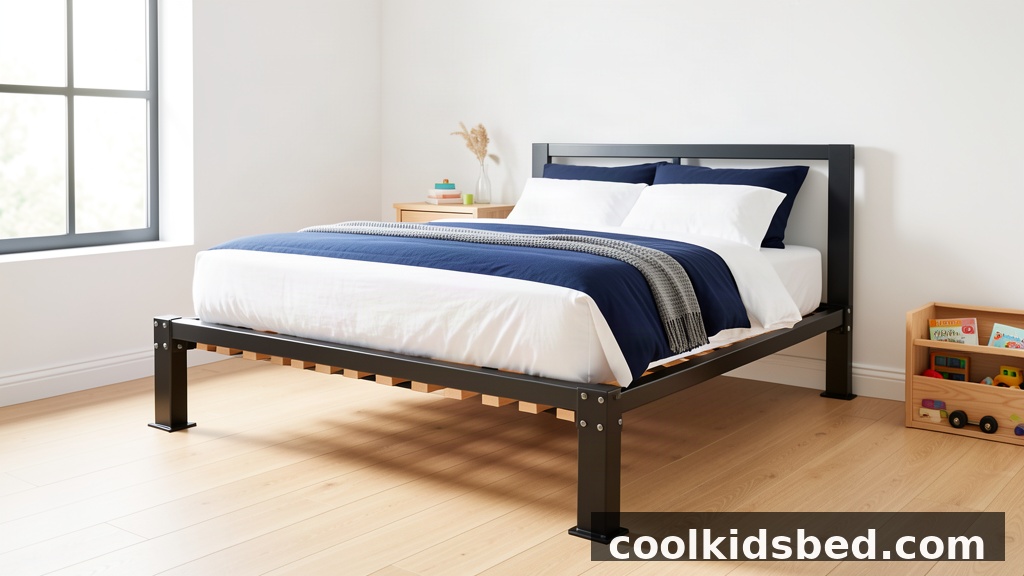
A strengthened bed frame is a bed base engineered with reinforced steel slats, thicker-gauge tubing, or added center support legs so it carries more weight and resists wobble than a standard frame. Manufacturers typically rate them from 350 lbs to 3,500 lbs — a range that matters enormously in a kids’ room, where jumping, climbing, and sleepover pile-ups are routine.
If you have ever heard a bunk bed groan under a nine-year-old, you already understand the problem. A frame that flexes on day one will squeak by month three and sag by year two. This guide walks through what actually makes a bed frame stronger, how to read the specs without getting sold marketing fluff, and which strengthened designs hold up best for children, tweens, and teens.
What “Strengthened” Really Means on a Spec Sheet
The word gets applied loosely. On most listings, a strengthened bed frame means one or more of four concrete upgrades:
- Thicker steel tubing. Budget platform frames often use 25 mm square tube. Reinforced models move to 30 mm or 40 mm, or switch from round legs to square structural legs that resist twisting. One popular 14-inch frame uses 1.77-inch square structural legs specifically because square geometry flexes less than round.
- More slats. A bare-bones twin frame might ship with 10 slats. Strengthened designs run 14 to 20, and every added slat shortens the unsupported span between supports — which is exactly where mattress foundations fail.
- Center support legs. Full, queen, and king sizes need a center rail with at least one — ideally two — legs reaching the floor. Look for “recessed middle legs,” which sit inboard so nobody stubs a toe on them at 2 a.m.
- Corner bracing and welded joints. Bolted corner plates and welded gussets are what stop a frame from developing the side-to-side sway that eventually strips screw threads.
When a manufacturer claims reinforcement but lists none of these four things, treat it as decoration.
Weight Capacity: How Much Does a Kids’ Bed Actually Need?
Here is a benchmark worth remembering. Standard twin and full bed frames in the $90 to $200 range are commonly rated around 200 to 400 lbs. Ruggedized metal platforms now advertise 3,500 lbs — far more than any child weighs, but that headroom is the point. A frame rated at 3,500 lbs is not being asked to work near its limit by a 70-lb sleeper and a friend, so it does not flex, and a frame that does not flex does not squeak.
Practical targets by age and sleeping arrangement:
- Toddler and preschool (under 50 lbs): a 200 to 250 lb rating is sufficient, provided the frame is stable to push against. Rails matter more than raw capacity at this age.
- School-age (50 to 90 lbs): aim for 300 lbs minimum. Kids at this stage use beds as trampolines.
- Tweens and teens (90 to 150 lbs): 400 lbs and up. Growth spurts arrive fast, and a teen bed often becomes a hangout couch.
- Bunk and loft configurations: the upper bunk needs its own rating. Quality rubberwood bunks commonly list 400 lbs upper and 400 lbs lower, while budget pine versions sometimes drop to 200 lbs per bunk — a meaningful difference.
If two children share a full-size bed for movie night, add their weights together and then double it. That is the number that should appear on the box.
Steel Versus Wood: Where the Strength Comes From
Both materials can be strengthened, but they fail differently.
Steel frames resist bending along their length exceptionally well. A 14-inch steel platform with 20 slats and recessed center legs is the strongest option per dollar, typically landing between $54 and $180. The trade-off is cosmetic: metal reads utilitarian, and cheap welds can pop under lateral force. Buy from brands that publish a load rating rather than a vague “heavy duty” badge. The yookare 14-inch metal platform bed frame is a good reference point here — it publishes a 3,500 lb rating, uses round anti-bump corners, and adds a recessed middle leg plus an anti-slip mattress stopper, which is the exact combination that keeps a mattress from sliding off a metal deck.
Solid wood frames — rubberwood, New Zealand pine, and hardwood blends — handle shock loads better, which is why they dominate the bunk and loft category. A strengthened wood frame usually means thicker side rails (often a full 1 inch instead of 0.6 inch), a slat-support rail running the length of the bed, and steel hardware rather than zinc-plated screws. Expect $180 to $450 for a well-built wood platform. Brands like DHP, Donco, Walker Edison, Merax, and Storkcraft all publish piece counts and slat counts on their spec sheets, which makes comparison shopping straightforward. A solid-wood option such as the Bellemave solid wood strengthened bed frame shows what that build looks like in practice, with a reinforced slat system and an adjustable headboard.
The honest answer: steel wins on rigidity per dollar, wood wins on shock absorption and looks. Bunk beds and lofts should almost always be wood. Flat platforms for a single sleeper can go either way.
Slat Count, Center Support, and the Wobble Test
You can evaluate a frame’s real-world rigidity in about ninety seconds once it is assembled:
- Push the headboard end sideways with moderate force. A strengthened frame moves less than half an inch; a weak one rocks visibly.
- Press down hard in the exact center of the mattress. Flex of more than an inch means the center span is unsupported.
- Walk around the perimeter and listen. Squeaks almost always come from metal-on-metal contact where a bolt has loosened, not from the mattress.
On mattress thickness, follow the manufacturer’s ceiling rather than your preference. Most bunk and loft frames specify 6 inches or less for the upper bunk, and some full-size loft designs cap it at 4 to 6 inches. Exceeding that raises the sleeping surface — and the child — above the guardrail safety line. A typical full-over-full bunk measures roughly 78.6″ L x 58″ W x 61.3″ H overall at about 180 lbs shipping weight, and the geometry is designed around a low-profile mattress.
Safety Standards a Strengthened Frame Should Meet
In the United States, children’s bunk beds are governed by the CPSC’s 16 CFR Part 1213 and the voluntary ASTM F1427 standard. Both require upper-bunk guardrails on all four sides, with the rail extending at least 5 inches above the mattress surface, and openings small enough that a child’s torso cannot pass through but large enough that a limb can. Look for a compliance statement in the listing, not just a brand promise.
Two more safety points that parents routinely overlook:
- Stability is not the same as strength. A frame rated for 3,500 lbs can still tip if it is not anchored. Wall-anchoring kits cost about $10 and take five minutes to install. They are the single highest-value upgrade available.
- Bunk ladders and stairs count as structural. A ladder that hooks onto a weak top rail transfers the child’s full weight into that rail every climb — several times a day. On a properly strengthened frame, the rails are rated for this. On a flimsy one, the hooks wallow out within a year.
How to Reinforce a Bed Frame You Already Own
Replacement is not always necessary. If the frame is structurally sound but flexing, these fixes cost far less than a new bed:
- Add a slat-support rail. A 1×3 or 2×2 hardwood rail bolted along the center of the frame, running headboard to footboard, eliminates most mid-span sag. Cost: $15 to $25.
- Upgrade the slats. Replace 10 thin slats with 14 to 20 thicker ones, or lay a 1/4-inch plywood decking sheet over the existing slats. Cost: $40 to $70.
- Re-torque every bolt. Loose fasteners cause the vast majority of squeaks. Tighten with a socket wrench, not a screwdriver, and add a thread-locking compound. Cost: under $10.
- Add center support legs. Bolt-on legs for full and queen frames run $20 to $35 a pair.
If the frame’s side rails are cracked, the welds are broken, or it is a 15-year-old hand-me-down with mismatched hardware, replace it. Structural repairs are not a DIY project in a child’s bedroom.
Matching the Frame to the Sleeper
Size drives reinforcement requirements more than age does:
- Twin (38″ x 75″): the shortest span, so it needs the least bracing. A 10 to 14-slat frame with a solid center is fine.
- Full (54″ x 75″): wide enough that center legs become necessary. Insist on them.
- Queen (60″ x 80″) and King (76″ x 80″): 20-slat designs with two center legs are the baseline, not an upgrade. Expect to pay $54 to $140 for a metal frame in this class.
- Bunk and loft: reinforcement is horizontal rather than vertical — cross-bracing between the two bunks, and a ladder or stair unit that ties into both the top and bottom rails.
For a deeper look at how steel frames compare across bunk configurations, see our complete guide to steel frame bunk beds, and if you are still weighing materials, the breakdown in our parent’s guide to buying kids metal beds covers the same ground from a purchasing angle. Families moving up to a larger shared bed will also find the weight and trundle ratings in our full over full bunk beds with trundle guide useful, since trundle platforms carry their own separate capacity limits — usually around 250 lbs.
What a Strengthened Frame Should Cost in 2026
Prices have flattened over the past two years, largely because steel and rubberwood costs stabilized. Reasonable 2026 ranges:
- Budget metal platform (twin/full): $54 to $100
- Mid-tier metal with center legs and 20 slats: $100 to $180
- Solid wood platform with reinforced slat support: $180 to $450
- Strengthened bunk bed (wood, with guardrails): $300 to $700
- High loft with desk or wardrobe built in: $450 to $900
Spending at the top of a range rarely buys more steel. It buys better hardware, cleaner welds, and a longer hardware warranty — the parts that actually decide whether the frame lasts ten years or three.
Common Questions Parents Ask
Does a strengthened frame need a box spring? Almost never. Modern reinforced platforms are designed to support a mattress directly, and adding a box spring on a metal deck raises the sleeping surface above the guardrail line on a bunk. If the listing says “no box spring needed,” believe it.
Is a heavier frame automatically stronger? No, though the correlation is decent. A 40 lb steel twin frame is usually stronger than a 25 lb one, but welded corner construction and slat count matter more than shipping weight alone.
How long should a kids’ bed frame last? A well-built strengthened frame should hold up for 10 to 15 years — long enough to see a child from a toddler bed through high school. Frames that fail within three years almost always fail at the fasteners first.
Can I use a strengthened adult frame for a child? Yes, and it is often the smartest buy, provided the frame has no sharp corners and is anchored to the wall. Round anti-bump corners have become standard on the better metal platforms for exactly this reason.
Bottom Line
Strength in a bed frame is not a marketing adjective — it is a combination of tube gauge, slat count, center support, and joint construction, and every one of those is visible on a spec sheet before you buy. Aim for a frame rated well above your child’s weight, insist on center legs at full size and above, follow the mattress thickness ceiling on anything elevated, and anchor the frame to the wall. Do those four things and you will not think about the bed again for a decade.
Browse our metal bed frames and bunk beds to compare reinforced designs side by side, or read our guard rail safety advice before you commit to a bunk configuration.