
Buying Guide
King Size Platform Bed with Storage: What Actually Fits
Oct
King Size Platform Bed with Storage: What Actually Fits
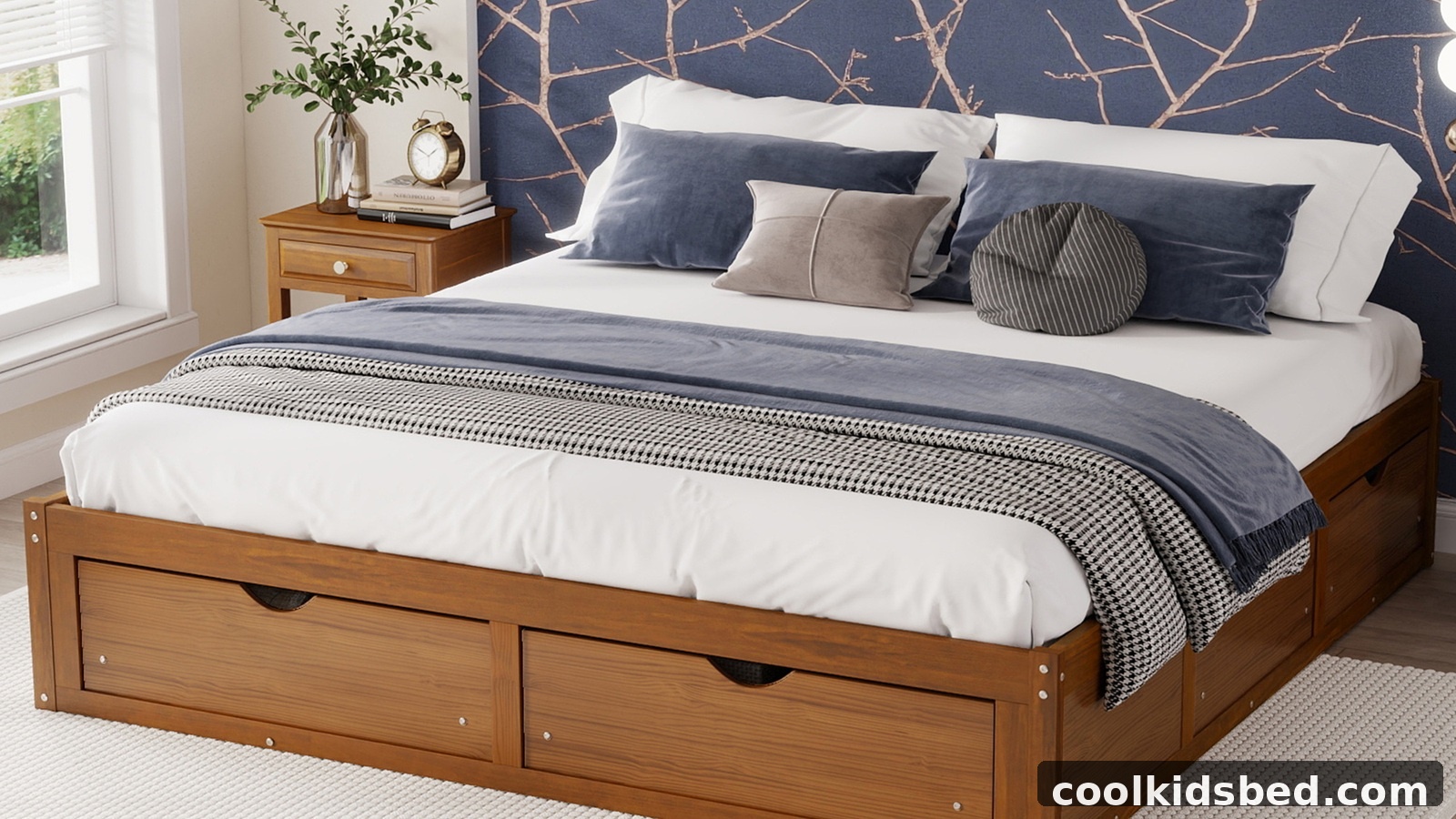
A king size platform bed with storage is a king bed whose mattress rests on a slatted platform deck with drawers, a lift-up cavity or shelving built into the frame itself. No box spring is needed, and the storage replaces floor space a dresser would otherwise occupy.
Most people shopping for a king size platform bed with storage start with the mattress size and stop there. That is where the trouble begins. The bed you receive is bigger than the mattress in both directions, and the drawers need floor space of their own, which means a frame that fits your room on paper can still be the wrong purchase once you open the first drawer.
This guide works from measured numbers: overall frame dimensions from five king storage beds we stock, drawer and deck measurements published by other retailers, and the fit complaints that keep appearing in owner reviews. By the end you should know exactly which measurements to take before you order.
Three kinds of storage, three different footprints
“Storage” is not one feature. On a king platform bed it usually means one of four arrangements, and each one changes what the bed demands from your room.
- Foot-end drawers. Drawers built into the footboard or the rail below it, facing the walkway at the end of the bed. They need clear floor in front of the bed, which most bedrooms have.
- Side drawers. Drawers that pull out toward the walls or toward a partner’s side. These are the ones that collide with nightstands, and the ones buyers regret.
- Pull-out cabinet or under-bed box storage. A deeper caster-mounted unit that slides out from the foot or side, usually with more volume than two shallow drawers.
- Lift-up (gas or hydraulic) storage. The whole deck hinges upward on struts to expose one large cavity. Maximum volume, but the platform has to travel upward and the mattress has to be lifted with it.
There is also the storage headboard, common on imported frames: open cubbies, a bookcase, or a shelf row above the pillow line. It adds storage without touching floor clearance, but it pushes overall height up substantially, which matters under a low ceiling or a window.
Measure the frame, not the mattress
The single most common fit error is treating “king” as a room plan. A king mattress occupies roughly 76 in wide by 80 in long, but the frames we sell run 78 to 79.6 in wide and 82.3 to 93.1 in long, because the overall figure includes the rails, the headboard and in some cases the drawer boxes. Published listings from other retailers land in the same range: 86.65 in, 91 in and 93 in long, with one storage-headboard model at 80.3 in wide.
| Model (what we stock) | Overall L x W x H (in) | Weight capacity | Slats | Mattress thickness guide | Frame weight |
|---|---|---|---|---|---|
| King Size Platform Bed with 6 Storage Drawers (pine) | 82.3 x 79.6 x 15.7 | 500 lb | Not listed | About 10 in | 137.8 lb |
| King Bed Frame with Storage Drawers, No Headboard (MDF, pine, plywood) | 82.3 x 78 x 22 | 600 lb | 10 | 8 in | 185 lb |
| Wood King Bed with Drawers and Pull-Out Storage Cabinet (pine) | 93.1 x 79.2 x 13 | 500 lb | 10 | 8 in | 156.2 lb |
| King Functional Vertical Striped Bed with Gas Lift Storage (fabric, eucalyptus, metal) | 88 x 70.5 x 44 | 500 lb | Not listed | Not listed | 130 lb |
| Wood King Bed Frame with Headboard, Noise-Free (plywood, pine, MDF; no storage) | 84.4 x 79 x 40.7 | 800 lb | Not listed | 8-10 in | Not listed |
Across published king storage bed listings, overall frame length runs from 82 in to 93 in while the mattress deck itself sits near 80 in. The extra inches are rails, headboard and drawer boxes, not sleeping surface.
Two rows in that table need a second look before you buy. The gas-lift frame is listed at 70.5 in wide, narrower than a king mattress, so confirm the deck measurement with us before ordering. The pull-out cabinet model is 93.1 in long and 13 in high: it is the longest bed here and the easiest to walk into, and it is the one to measure twice in a room with a doorway at the foot of the bed.
Also measure the route, not just the room. A king frame arrives in two packages and the rails are long. Doorways, hall turns and stair landings are where king beds actually fail to deliver, and a 93 in rail will not pivot in a 30 in hallway.
Drawer clearance: the number that decides whether storage works
Published drawer boxes on king storage beds measure about 17 to 22 in deep and 5 to 6 in tall: one 2-drawer model lists drawers at 22.1 x 17.56 x 5.12 in, and an 8-drawer model lists 24 x 21.5 x 6 in. Whatever the exact figure, the drawer needs that much clear floor to open, plus a few inches for the handle and your knuckles.
Drawer depth is the number that decides whether the storage is usable. A 22 in drawer box needs 22 in of clear floor in front of it, so a side drawer facing a nightstand at 24 in from the rail will not open past a few inches.
Owner reviews describe this exact failure more often than any other. A Prepac owner reports that matching nightstands blocked the side drawers, and a Wayfair reviewer describes drawers at the back of the bed’s side that could not open with nightstands in place.
A realistic rule for a king bed with side drawers:
- Leave about 24 in of clear floor beside the bed on any side with drawers, and keep nightstands narrower than that gap or move them to the head end.
- Prefer foot-end drawers if your bed sits between two walls. The walkway at the foot of a king bed is usually the only reliably open floor in the room.
- Check the floor surface. Drawers that run on the floor rather than on tracks bind on thick carpet, and reviews of wheeled drawers describe them failing to line up when pushed back.
What a weight rating actually covers
Stated capacities on the king storage beds in our table run from 500 lb to 800 lb, and published listings elsewhere span 500 lb to 1,000 lb. The figure applies to the complete assembly, meaning slats, center supports, rails and joints together, not to the frame in isolation.
Two construction details tell you more than the headline number. Slat count is published on some frames (10 slats on two of ours) and a platform deck with 10 closely spaced slats distributes load better than a sparse deck. Material is the other: pine and MDF frames in the 500-600 lb class, plywood and metal combinations at 800-1,000 lb. Neither material name proves a capacity; the rating is a manufacturer claim, and US listings rarely quote an independent test.
EN 1725 is the European standard covering bed safety, strength and durability testing. A frame that cites it has been tested against a published method; a frame that only prints a pound figure has not told you how that figure was reached.
Mattress thickness matters as much as the frame. Our listings guide 8 in to 10 in, and one storage-headboard listing recommends 6-10 in. A mattress much thicker than the guide sits proud of the rails, hides the deck edge and, on a lift-up bed, adds weight the struts were not sized for. Whatever mattress you choose has to meet the federal flammability standard in 16 CFR Part 1633, which applies to the mattress rather than the frame.
Drawers or lift-up? Decide on ceiling and mattress
Both work; they fail in different rooms.
Choose drawers when the bed sits against a wall with walkway at the foot, when the mattress is heavy, and when you want storage you can reach without moving bedding. Six drawers in a pine frame at 82.3 in long is the most forgiving combination for a normal bedroom, and the 6-drawer king platform bed is the version most buyers should start from.
Choose lift-up when you need volume for luggage, bedding or seasonal storage, and when the ceiling above the bed is clear. The platform has to rise far enough to clear the mattress, so a sloped ceiling, a ceiling fan or a low window behind the headboard rules it out. Our gas-lift storage bed carries a 500 lb capacity and a 130 lb frame, so the deck and mattress together are what you are lifting.
Choose the no-headboard frame when the bed goes under a window or into an alcove and the headboard would fight the architecture. The storage-drawer platform without a headboard is 22 in high with 10 slats and a 600 lb rating, and it is the easiest of the group to place against a wall.
If storage is not the priority and clearance underneath is, a plain frame is lighter and cheaper to build well. Our king size metal platform bed frame guide covers the fit and load math for that route, and the full platform bed collection lists every deck height we carry.
Five mistakes that turn up in owner reviews
- Planning from the mattress size. Overall frame dimensions are larger in both directions. Measure the assembled width and length from the listing, then measure the room.
- Ignoring drawer swing. Nightstands, walls and radiator covers all sit exactly where side drawers need to open.
- Assuming drawers glide on every floor. Floor-running drawers and wheeled baskets struggle on carpet and can fail to align when pushed back.
- Forgetting the delivery route. Long rails need a turning radius. Check the doorway, the stairwell and the last corner before the bedroom.
- Buying too thick a mattress for a lift-up bed. Beyond the recommended thickness the deck may not close cleanly and the struts work harder than intended.
King Size Platform Bed with Storage: browse the ranges side by side
These collections are grouped the way buyers actually narrow down this choice, so the specs you need are one click apart.
- king size platform bed with storage
- king size platform bed with headboard
- full size platform bed with storage
- king size platform bed
- Platform Bed collection
- King Size Bed collection
Frequently asked questions
Does a king platform bed with storage need a box spring?
No. A platform bed has a slatted deck that supports the mattress directly, and our king storage models are all listed as no box spring required. Adding one raises the mattress above the rails, hides the deck and can interfere with a lift-up mechanism, so skip it.
How much space do I need beside a king bed with side drawers?
Plan on about 24 in of clear floor on any side with drawers. Published drawer boxes are roughly 17 to 22 in deep, and you need a few inches beyond that for your hand. Nightstands wider than the gap, or placed directly in front of a drawer, block it.
What is the real footprint of a king storage bed?
Larger than the mattress. The king beds we stock run 78 to 79.6 in wide and 82.3 to 93.1 in long, against a mattress footprint of about 76 x 80 in. Always plan from the overall dimension in the listing, not from the word “king”.
Are the drawers strong enough for bedding and clothes?
Every model we stock rates the bed at 500 lb or more, and drawer boxes at 5 to 6 in tall are sized for folded clothes, bedding and shoes rather than heavy gear. Load the frame within its stated capacity and keep very heavy items in the larger pull-out cabinet or lift-up cavity.
Can two people assemble a king storage bed?
Usually yes, in a few hours. Both packages are long and the deck is heavy, so two people are needed to lift the rails and set the slats. Our storage models ship in two packages, and the pull-out cabinet model is the heaviest to handle alone.
Bottom line
Buy the frame that fits your floor plan and your drawer clearance, not the one that fits your mattress. Measure the overall dimensions, walk the delivery route, leave about 24 in wherever a drawer opens, and match mattress thickness to the listing’s guide. Start with the king size bed collection if you want to compare deck heights and finishes, or go straight to the pull-out cabinet model if volume matters more than a low profile.
Two reference points outside our catalogue, both listed with four underbed drawers: the Allewie King Size Storage Bed Frame with 4 Underbed Drawers, and for the lift-up route the HISOFT King Size Lift Up Storage Bed Frame.