
Buying Guide
King Size Metal Platform Bed Frame: Fit, Load and Clearance
Oct
King Size Metal Platform Bed Frame: Fit, Load and Clearance Numbers
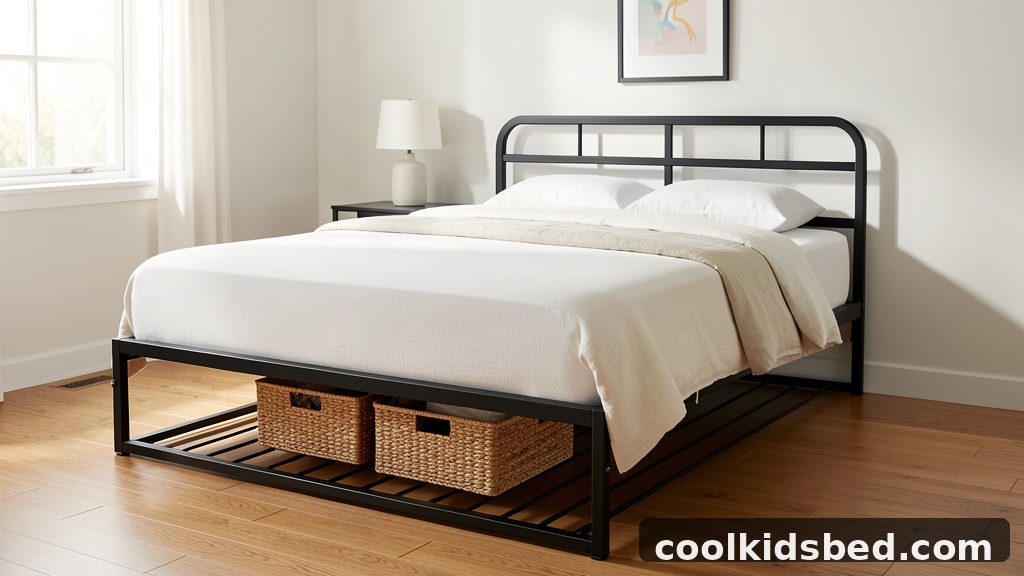
A king size metal platform bed frame is a steel, or steel-and-wood, bed base built for a 76-by-80-inch king mattress, with slats that carry the mattress directly so no box spring is needed. That definition is simple. The buying decision is not, because the frames sold under that name publish overall lengths from 79.5 to 84.4 inches, clearance from 11 to 13 inches, and load ratings from 500 lb to 3,500 lb.
This guide works through those numbers using published specifications only: six current US listings, the four king-size platform beds in our own catalogue, and the one metal platform frame we stock. Where a listing does not publish a figure, this page says so rather than filling the gap.
Start with the mattress, not the frame
A standard U.S. king mattress measures 76 by 80 inches (193 by 203 cm); a California king measures 72 by 84 inches. A frame built for one will not fit the other, and the word “king” on a product title does not tell you which one the seller means.
The check that settles it is the interior platform size, not the overall dimension. Our king size platform bed frame with headboard and wood slat support publishes an overall size of 83.7 by 79.6 by 40.6 inches and a platform of 80.1 by 77.2 inches. The platform is 0.1 inch longer and 1.2 inches wider than a standard king mattress, so the mattress drops in with a small margin rather than being squeezed. An overall width of 79.6 inches, by contrast, is 3.6 inches wider than the mattress because the side rails and headboard posts are included in that figure.
Measure the wall run before anything else. A 84.4-inch-long frame leaves 4.4 inches more floor than an 80-inch-long one, and in a room where the bed sits between two doorways that difference decides whether the frame goes in at all.
What six real king metal frames publish
The table below is taken from six current listings at US retailers. The spread is the point: these are all “king size metal platform bed frames,” and no two agree on height, clearance, or capacity.
| Frame | Overall size (L x W x H) | Under-bed clearance | Listed capacity |
|---|---|---|---|
| Yaheetech metal frame with spindle headboard | 83 x 79 x 37.5 in | 13 in | 800 lb |
| Yaheetech iron frame, high headboard | 82.5 x 78.5 x 42 in | 12.6 in | 794 lb |
| NKZ 14-inch king platform | 79.5 x 75.5 x 14 in | 12.4 in | 3,500 lb |
| VEVOR king frame with headboard | 84.1 x 78.2 x 39 in | 12 in | 1,000 lb |
| Costway king frame with headboard and footboard | 83.5 x 76.5 x 34.5 in | 11 in | 500 lb |
| Slickblue steel frame with poplar slats | 80 x 76 x 11 in | Not published | Not published |
Under-bed clearance on these frames runs from 11 to 13 inches, which is enough for flat storage bins and a vacuum head, and not enough for a deep drawer unit. If under-bed storage is the reason you are buying a platform frame, plan for bins rather than drawers, or buy a frame with drawers built in.
One figure in the table needs care. The NKZ frame’s overall length of 79.5 inches is shorter than the 80-inch king mattress it is sold for, because that listing measures the frame between its outer rails and the mattress overhangs slightly at each end. A shorter overall figure is not automatically a fit problem, and a longer one is not automatically generous; only the interior platform dimension answers the question.
Load ratings from 500 lb to 3,500 lb
Advertised load ratings on king metal frames in this review span 500 lb to 3,500 lb, and most listings do not say whether the figure includes the mattress. The range is real, but it is a range of claims rather than a range of tested performance, and the difference matters when two adults share a bed.
Three published figures show how the ratings are worded. The Zinus Lorelai king frame is listed at 700 lb. The Emma and Oliver 14-inch king frame is listed at 800 lb. One heavy-duty listing states 1,300 lb with the qualifier “evenly distributed,” which is the most honest phrasing in the group because it names the condition the number depends on.
Treat a rating as a ceiling set by the seller, and read it together with three things it does not cover: the number of legs and the position of the center rail, whether the legs sit on a carpeted floor or a hard floor, and whether the frame has a center support that reaches the ground. A 3,500 lb claim on a frame with a single center leg is a different product from a 700 lb claim on a frame with three cross rails and six legs, even though the first number is five times larger.
Slat spacing: the number the listing leaves out
Slat spacing decides whether a foam or hybrid mattress keeps its warranty, and it is the figure most king frame listings simply omit. None of the six listings in the table above published a spacing measurement, and the two king models in our own catalogue publish slat counts instead: our king platform bed with 6 storage drawers and our king bed frame with storage drawers and no headboard both list 10 slats, with no spacing figure.
A slat count is not a spacing figure, because the same 10 slats can be spread over an 80-inch length at 8 inches apart or bunched at 6. Foam and hybrid mattresses are the ones most exposed to wide gaps, because a soft deck with nothing under it sags between the slats, and a sag the mattress maker attributes to the frame is a warranty claim that gets refused. Ask the seller for the spacing in inches before you order.
Steel, steel-and-wood, and the king-size trade-off in our catalogue
Construction on these frames falls into three groups. All-steel frames use steel rails and steel slats; the Emma and Oliver listing describes 19-gauge solid steel. Mixed frames use a steel structure with timber slats, such as the Slickblue frame’s poplar slats or the Zinus Chestnut frame’s bamboo components and wood slats. All-timber frames use pine, MDF, or plywood, and a steel center rail is often the only metal in them.
At king size, our own range is the third group. Every king platform bed we sell is timber-based, and the metal platform frame in the catalogue is a queen. That is simply where our range sits at king size, and it changes what we can honestly recommend to a shopper who wants an all-steel king frame.
| Model (ours) | Size | Overall size (L x W x H) | Rated load | Slats | Mattress guidance |
|---|---|---|---|---|---|
| Platform bed frame with headboard, wood slat support | King | 83.7 x 79.6 x 40.6 in | 400 lb | Not published | 8-10 in |
| Platform bed with 6 storage drawers | King | 82.3 x 79.6 x 15.7 in | 500 lb | 10 | About 10 in |
| Wood king bed frame, noise-free design, no box spring needed | King | 84.4 x 79 x 40.7 in | 800 lb | Not published | 8-10 in |
| King bed frame with storage drawers, no headboard | King | 82.3 x 78 x 22 in | 600 lb | 10 | 8 in |
| Queen size metal platform bed frame with trundle, USB ports and slat support | Queen | 86.2 x 61.8 x 39 in | 400 lb bed; 350 lb trundle | 13 bed; 16 trundle | 6-8 in on the bed; 4-6 in on the trundle |
The metal platform frame we stock is a queen, 61.8 inches wide, which is 14.2 inches narrower than a king mattress. A king mattress will not sit on it, and no amount of overhang makes that safe. If metal construction is the requirement at king size, the frames in the first table are where to shop, and the numbers above are what to compare them on.
If the requirement is a king bed with storage or a tall headboard, our timber platforms do the job and publish the figures: the wood king bed frame with headboard and noise-free design carries the highest rating in our range at 800 lb, and the six-drawer model brings the overall height down to 15.7 inches so the bed reads lower in a room with a sloped ceiling. For the full range, the king size bed collection lists all 38 king models, and the metal bed collection covers the steel frames we carry in smaller sizes.
Two Amazon listings are worth putting next to those figures if you are set on steel. The Linenspa 14-inch king metal platform bed frame is the long-running budget option in this category, and the NKZ 14-inch king metal platform frame with round corner legs is the frame carrying the 3,500 lb claim and four mattress stoppers. Compare their slat counts and leg layout against the table above rather than against their own marketing copy.
Clearance, drawers, and the floor space a king frame eats
A king frame is a large object and the room around it is usually the constraint. The frames in the first table run from 75.5 to 79 inches wide, so a 76-by-80-inch mattress plus a nightstand on each side needs at least 76 inches of wall, and 82 inches is safer once you allow for the headboard posts.
Storage changes the arithmetic. Our six-drawer king platform is 15.7 inches tall overall, so the mattress deck sits well below the 40.6-inch headboard models and the bed reads lower in the room. Its drawers open to the side, so it needs clearance at the side or the foot of the frame rather than underneath it. The drawer-free model at 22 inches tall gives you the same low profile without the drawer swing.
If the plan is bins under the frame, the 11-to-13-inch window in the first table is the number to hold onto. A bin is usually sold by its body height, and the casters or the lid add to that, which is why shoppers who measure the frame height and not the bin end up returning it.
Assembly and noise: what owners report
The complaints on king metal frames cluster around one theme: parts that do not seat where the instructions say they will. Linenspa buyers describe slats cut too long for their grooves and center bars that appear too short, and one reviewer reports a click-in design that lets parts slip out of place. None of that is structural failure; it is a quality-control problem that shows up in the first hour of assembly.
Two habits prevent most of it. Lay every slat into its groove before tightening anything, so you can see whether the pattern closes evenly at both ends, and check that the center rail and its legs actually reach the floor once the frame is loaded rather than floating a quarter inch above it. Then re-tighten every bolt after the first week of use, which is when steel joints bed in and a frame that was silent in the showroom starts to click.
A five-minute check before you order
- Confirm the mattress size. King is 76 by 80 inches; California king is 72 by 84 inches. Check the frame’s interior platform, not its title.
- Measure the wall run. Overall frame length runs from 79.5 to 84.4 inches in the listings above. Add nightstand width on both sides.
- Ask for slat spacing in inches. Match it to your mattress warranty before you buy, not after the mattress sags.
- Decide bins or drawers. Clearance of 11 to 13 inches takes bins; drawers need to be built into the frame.
- Read the rating as a claim. Check leg count, center support, and whether the figure is qualified as evenly distributed.
King Size Metal Platform Bed Frame: where to see the full range
These collections are grouped the way buyers actually narrow down this choice, so the specs you need are one click apart.
- king size platform bed frame
- king size platform bed with headboard
- full size platform bed frame
- king size platform bed
- Platform Bed collection
- Metal Bed collection
Frequently asked questions
Is a king size metal platform bed frame strong enough for two adults?
Four of the five frames that publish a rating carry 500 lb or more, three of them between 794 and 1,000 lb, and one claims 3,500 lb. Two adults and a mattress usually fall well inside those figures, but the rating assumes the load is spread across the deck, so check that the center rail and its legs reach the floor. A frame with a floating center support carries the weight on the side rails alone.
Do I need a box spring on a king metal platform frame?
No. A platform frame has slats that support the mattress directly, which is why the listings say “no box spring needed.” Adding a box spring raises the sleeping surface by several inches and can put it above the headboard line, so skip it unless the frame’s own instructions say otherwise.
What is the difference between a king and a California king frame?
A standard king mattress is 76 inches wide and 80 inches long; a California king is 72 inches wide and 84 inches long. The California king is narrower and longer, so a standard king frame leaves the mattress overhanging at the ends and short at the sides. Confirm the mattress size on the frame’s spec line before ordering either one.
How much clearance is there under a king metal platform frame?
The frames reviewed publish 11 to 13 inches of under-bed clearance, with one frame stating 12.4 inches of storage space. That fits flat bins and a vacuum head. It does not fit a deep drawer unit, and it is measured from the floor to the underside of the deck, not to the top of the side rail.
Can a king mattress go on a queen metal platform frame?
No. Our queen metal platform frame is 61.8 inches wide, and a king mattress is 76 inches wide, so 14.2 inches of mattress would hang past the rails with nothing under it. Mattress size and frame size have to match, and an oversized mattress on an undersized frame is how platform beds get damaged.
{“@context”:”https://schema.org”,”@type”:”FAQPage”,”mainEntity”:[{“@type”:”Question”,”name”:”Is a king size metal platform bed frame strong enough for two adults?”,”acceptedAnswer”:{“@type”:”Answer”,”text”:”Four of the five frames that publish a rating carry 500 lb or more, three of them between 794 and 1,000 lb, and one claims 3,500 lb. Two adults and a mattress usually fall well inside those figures, but the rating assumes the load is spread across the deck, so check that the center rail and its legs reach the floor. A frame with a floating center support carries the weight on the side rails alone.”}},{“@type”:”Question”,”name”:”Do I need a box spring on a king metal platform frame?”,”acceptedAnswer”:{“@type”:”Answer”,”text”:”No. A platform frame has slats that support the mattress directly, which is why the listings say \”no box spring needed.\” Adding a box spring raises the sleeping surface by several inches and can put it above the headboard line, so skip it unless the frame’s own instructions say otherwise.”}},{“@type”:”Question”,”name”:”What is the difference between a king and a California king frame?”,”acceptedAnswer”:{“@type”:”Answer”,”text”:”A standard king mattress is 76 inches wide and 80 inches long; a California king is 72 inches wide and 84 inches long. The California king is narrower and longer, so a standard king frame leaves the mattress overhanging at the ends and short at the sides. Confirm the mattress size on the frame’s spec line before ordering either one.”}},{“@type”:”Question”,”name”:”How much clearance is there under a king metal platform frame?”,”acceptedAnswer”:{“@type”:”Answer”,”text”:”The frames reviewed publish 11 to 13 inches of under-bed clearance, with one frame stating 12.4 inches of storage space. That fits flat bins and a vacuum head. It does not fit a deep drawer unit, and it is measured from the floor to the underside of the deck, not to the top of the side rail.”}},{“@type”:”Question”,”name”:”Can a king mattress go on a queen metal platform frame?”,”acceptedAnswer”:{“@type”:”Answer”,”text”:”No. Our queen metal platform frame is 61.8 inches wide, and a king mattress is 76 inches wide, so 14.2 inches of mattress would hang past the rails with nothing under it. Mattress size and frame size have to match, and an oversized mattress on an undersized frame is how platform beds get damaged.”}}]}The short version
Buy the frame that matches your mattress dimensions, then compare four published numbers: interior platform size, under-bed clearance, slat spacing, and a load rating you can read as a claim rather than a promise. At king size our catalogue answers with timber platforms from 400 to 800 lb, and the steel platform frame we stock is a queen. If steel at king size is the requirement, the listings in the first table are the honest starting point, and the platform bed collection is where to see how the same deck design is built in wood.