
Buying Guide
Wood Twin Size Daybed: The Complete Buying Guide for Parents in 2026
Aug
Wood Twin Size Daybed: The Complete Buying Guide for Parents in 2026
A wood twin size daybed is a twin-width bed frame built from solid or engineered wood that doubles as a sofa during the day, making it one of the most versatile pieces of kids’ furniture for small bedrooms, playrooms, and guest rooms. Because it uses a standard twin mattress, it grows with your child from age four through the teen years without needing an expensive specialty mattress.
If you have spent more than ten minutes looking at kids’ beds online, you already know the options can feel endless. Metal frames, upholstered platforms, loft beds, bunk beds, and daybeds all compete for the same corner of a small bedroom. The wood twin size daybed keeps showing up in family forums and design boards for a simple reason: it does three jobs with one footprint. It is a place to sleep at night, a sofa for reading or screen time during the day, and a spare bed for sleepovers when a friend stays over.
This guide walks through what actually matters when you shop for one, so you can skip the marketing fluff and pick a frame that will survive nightly jumping contests and weekend fort-building sessions.
Why Families Choose a Wood Twin Size Daybed
The biggest advantage of a wood twin size daybed is the dual-use design. A typical daybed measures about 76 inches long and 40 inches wide on the inside, which matches a standard twin mattress (39 x 75 inches) with a little breathing room. Because the frame has three raised sides instead of a traditional headboard-and-footboard layout, it hugs the wall and reads as a built-in piece. Parents who decorate with a coastal, farmhouse, or cottage theme usually prefer wood because it warms up a room in a way that powder-coated metal cannot.
Durability is the second reason. A well-built pine or rubberwood frame rated for 275 to 450 pounds holds up to a lot more than the average eight-year-old throws at it. Compare that to lightweight metal tube frames, which tend to wobble at the joints after a couple of years of active use. Wood frames also do not transfer cold, so sitting on the edge of the bed in the morning is more comfortable during winter months.
Finally, there is the space-saving angle. Many wood twin daybeds come with one or two drawers built into the base, which turns wasted under-bed space into storage for bedding, out-of-season clothes, or board games. If your child’s room is under 100 square feet, those drawers can replace a whole dresser.
Key Specs to Check Before You Buy
Not every wood twin size daybed is built the same, and the spec sheet tells you more than the photos do. Here are the numbers to look for:
- Weight capacity: Look for at least 275 pounds, ideally 350 pounds or more, so the frame still feels solid when your kid sits on the edge or a parent sits down to tuck them in.
- Slat count and spacing: Ten wooden slats with gaps no wider than 3 inches give a firm, safe mattress base. Wider gaps can let a low-quality mattress sag between slats over time.
- Box spring requirement: Most modern wood daybeds say “no box spring needed” because the slats support the mattress directly. That saves you $80 to $150 compared with a frame that requires both box spring and mattress.
- Dimensions: A standard twin daybed runs roughly 76 to 80 inches long, 40 to 42 inches wide, and 32 to 36 inches tall at the back. Measure your room and hallway before ordering, including doorways and stair landings.
- Finish and material: Solid pine and rubberwood are the most common choices in the $180 to $450 price range. Frames labeled “solid wood and MDF” combine real wood with engineered panels, which is fine for the side rails but check that the legs and frame joints are solid wood.
One more spec worth checking is the mattress thickness recommendation. Most frames work best with a 6- to 8-inch mattress, and the guardrails on each side sit low enough that a too-thick mattress makes the bed feel like a cage. If your child is a restless sleeper, pair the daybed with a thicker mattress and a bed rail for the open side.
Solid Wood vs. Engineered Wood: What the Labels Mean
Brands like Merax, DHP, Walker Edison, Donco, and Storkcraft all sell wood twin daybeds, but they use different materials under the same “wood” umbrella. Solid pine is the workhorse of this category. It is light enough to move around the room, takes paint and stain well, and develops a nice patina as it ages. Rubberwood, which is actually a sustainable hardwood harvested from plantation trees, is denser and heavier, so it tends to feel more premium at a similar price point.
Engineered options like MDF and plywood show up on the less expensive end of the range. MDF gives a smooth, uniform surface that paints beautifully, but it dents more easily and does not like moisture. For a kids’ room where spills happen, look for frames that use MDF only for decorative panels while keeping the structural rails and legs in solid wood.
A quick test when you read listings: if the description says “solid wood construction” without naming the species, it is usually pine. If it lists “MDF + solid wood,” expect a mix. Neither is automatically bad — the price should reflect what you are getting. A $200 frame with MDF panels can be a perfectly good starter bed; just do not expect it to survive a move to a new house the way a full-solid-wood frame at $400 will.
Storage Options That Make the Frame Earn Its Keep
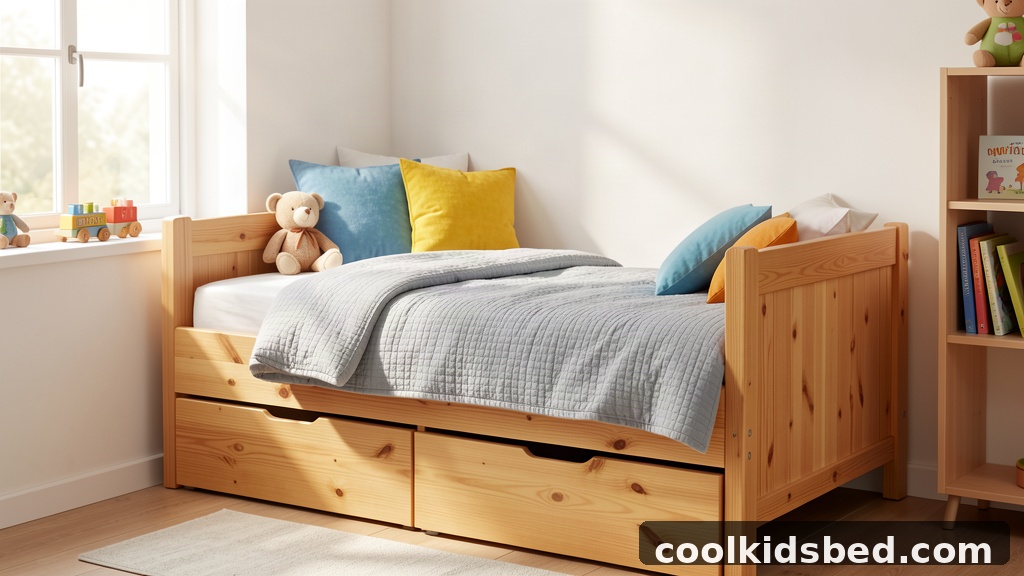
The most popular configuration for a wood twin size daybed in a kids’ room is the two-drawer version. The drawers slide out from the front, which means you do not need to pull the bed away from the wall to access storage. Each drawer is typically deep enough for folded clothes, extra blankets, or a collection of picture books, and the whole unit replaces a standalone dresser in rooms where floor space is tight.
If you are furnishing a guest room or a playroom that occasionally becomes a bedroom, check out our guide to the best full-size wooden daybeds for a close look at how larger frames handle the same storage question. For smaller rooms, the drawer layout matters more than the size — choose frames where the drawers glide on metal runners rather than wood-on-wood, because kids will pull them open a hundred times a day.
Some daybeds skip drawers entirely and leave the base open, which gives you a crawl-space hideout that kids love but that tends to collect dust bunnies and lost socks. If you go that route, a couple of flat storage bins tucked under the bed give you the same storage without paying extra for integrated drawers.
Daybed vs. Trundle vs. Loft: Which Layout Fits Your Room
It helps to compare a wood twin size daybed with the other space-saving layouts before committing. A daybed with a trundle adds a second mattress on a rolling platform underneath, which is the best choice if sleepovers are a regular event in your house. The trundle mattress slides out at night and tucks away during the day, so the footprint stays the same. Our guide to white daybeds with trundles covers how that configuration works in practice, including which trundle mattress thickness to buy.
A loft bed takes the opposite approach: it raises the sleeping surface several feet off the ground and frees up the floor below for a desk or play area. That works brilliantly in rooms taller than 8 feet, but it is not ideal for kids under six because of the climbing risk. A daybed keeps the sleeping surface close to the floor, which makes it the safer pick for younger children and for any room where you want the bed to double as seating.
If your child is older and homework space is the priority, a twin size loft bed with stairs might serve you better. But for most families, the daybed wins on simplicity: no ladder to climb, no height limit, and a lower center of gravity that feels sturdier.
Safety Checklist for a Kids’ Room Daybed
Safety comes down to a handful of specifics that are easy to verify:
- Guardrails: The two long sides of a daybed act as built-in rails, which is a big safety win for toddlers and young kids who roll in their sleep. The rail height should be at least 5 inches above the mattress surface.
- Corner hardware: Check that all bolts and screws are recessed or covered, and that there are no sharp metal corners at kid-head height.
- Weight rating: Confirm the listed capacity covers your child plus any siblings who will jump on the bed. A 275-pound rating is the practical minimum.
- Non-toxic finish: Look for finishes that are labeled low-VOC or water-based. This matters more in a small, poorly ventilated room where the new-furniture smell lingers.
- Stability: Give the frame a gentle side-to-side push before you commit. A solid wood daybed should not flex or creak at the joints.
Assembly is part of the safety equation too. Most wood daybeds arrive as a flat-pack kit with 20 to 40 pieces, and the average build takes one adult about 45 to 90 minutes. Have a second person help with the larger panels, and tighten every bolt twice — once during assembly and again after the first week of use, because wood compresses and joints loosen.
How Much Should You Pay for a Wood Twin Size Daybed
Realistic pricing in 2026 lands most wood twin size daybeds in the $180 to $450 range. At the bottom of that range, you get a solid pine frame with basic slats and no storage. Around $250 to $350, you start finding the two-drawer configurations from brands like Merax and Donco, which is the sweet spot for most families. Above $400, you are paying for denser hardwoods, better joinery, and finishes that resist scratching.
Keep an eye on shipping fees, which can add $30 to $80 for a large flat-pack box. Some retailers bundle free shipping into the price, so compare the total delivered cost rather than the sticker price. Sales around Memorial Day, Labor Day, and Black Friday routinely take 15 to 25 percent off this category, which makes late May and November the cheapest months to buy.
Our Recommended Pick for Most Families
For the combination of price, storage, and build quality, the Merax Pine Wood Twin Daybed with 2 Drawers is a strong all-around choice. It uses pine construction with ten slats, needs no box spring, and pairs a daybed layout with two usable drawers — everything a small kids’ room actually needs. The espresso finish hides scuffs better than white, which is worth considering if your child is rough on furniture.
Check the current price of the Merax Pine Wood Twin Daybed on Amazon and compare it against the two-drawer options from Danxee and Rockjame in the same price band. Prices move often, so the listing price today is the best guide.
Styling Ideas: Making the Daybed Feel Like Theirs
Once the frame is in, the fun part begins. A wood twin size daybed takes well to a layered bedding look: a fitted sheet in a solid color, a quilt or duvet in a print, and two or three throw pillows against the back rail. Since the frame is a neutral backdrop, you can change the whole mood of the room with a new duvet cover instead of new furniture.
For storage-savvy rooms, our roundup of the best daybed with storage ideas for small apartments shows how the same frame works in dens, offices, and guest corners — the styling tricks transfer straight to a kids’ room. Add a low bookshelf at the foot of the bed and a small side table with a reading lamp, and you have a complete sleep-and-play zone in under 80 square feet.
If your budget allows, upgrade the mattress to a 7- or 8-inch hybrid or memory foam model in the 10 to 12 pound density range. That single upgrade does more for sleep quality than any frame feature, and it keeps the daybed comfortable for the years when your child uses it as a couch.
Bottom Line
A wood twin size daybed earns its place in a kids’ room by doing what no other single piece of furniture can: sleeping one child comfortably, seating two or three for movie night, and hiding a surprising amount of clutter — all in one footprint. Focus on weight capacity, slat spacing, and solid-wood structural parts, budget $250 to $350 for a frame with drawers, and pair it with a good 8-inch mattress. That combination has carried families through the toddler years, the school years, and every sleepover in between.