
Buying Guide
Corner Bunk Beds for Kids: The Complete Buying Guide for 2026
Sep
Corner Bunk Beds for Kids: The Complete Buying Guide for 2026
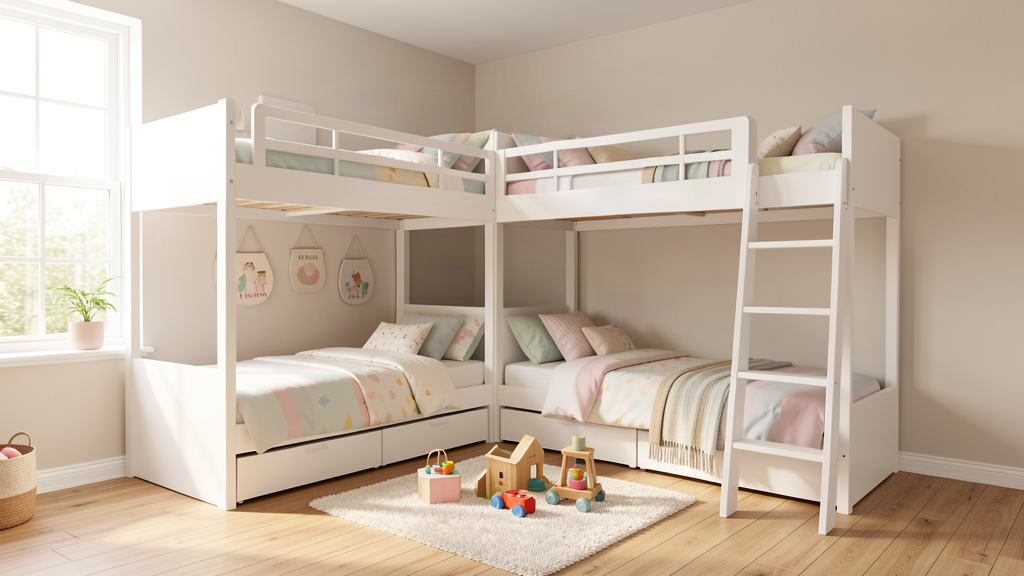
A corner bunk bed is an L-shaped bed frame that places one mattress along a wall and a second mattress along the adjacent wall, meeting at a 90-degree corner so two kids share one compact footprint. It turns an awkward corner into a full sleep setup while leaving the middle of the room open for play, desks, or storage.
Walk into most kids’ rooms and you will find the bed pushed against a wall with wasted space in the corner. A corner bunk bed (often sold as an L-shaped bunk) does the opposite: it uses that 90-degree junction as the anchor for two stacked beds, which is why it keeps showing up in room plans for siblings who share a bedroom. Before you order one, it helps to understand the sizing, the safety rules, and the price bands, because corner frames are built differently from straight twin-over-twin bunks.
What Counts as a Corner Bunk Bed
True corner bunks are L-shaped: the top bed runs along one wall and the bottom bed runs along the wall next to it, with a shared corner post holding both. The layout gives the lower sleeper a bed that sits at a right angle to the upper bed, not directly beneath it, which is a real advantage for kids who feel closed in. Straight bunks stack both mattresses over each other; corner bunks offset them. That offset is also why corner frames need more wall space than a standard bunk but leave the center of the room clearer.
Most corner models are twin over full, meaning the upper bed fits a twin mattress while the lower bed fits a full mattress. Triple L-shaped versions add a second lower twin along the other wall, sleeping three kids in roughly the same corner footprint. If you are comparing layouts, our guide to twin over full bunk beds walks through when that combination makes sense for two kids of different ages.
Room Measurements That Matter
Measure before you shop, not after the box arrives. A typical twin-over-full corner bunk needs about 60 to 75 inches of clear wall on each side, and the unit itself stands roughly 65 to 70 inches tall. That means a standard 8-foot ceiling works, but a room with a sloped ceiling or a ceiling fan directly above the corner can rule out an upper bunk entirely.
Three numbers settle most decisions:
- Wall run: add 6 inches of clearance beyond the bed on each open side so kids can make the bed and climb safely.
- Ceiling height: leave at least 30 inches between the top mattress surface and the ceiling so the child on top can sit up without bumping their head.
- Door swing: corner bunks sit low in the room’s traffic path; check that the door and closet still open fully before committing.
Rooms under about 9 by 10 feet are where corner bunks shine. If you need even more vertical storage instead, a twin size loft bed with stairs lifts one mattress high and clears the floor underneath, which is a different trade-off worth comparing.
Safety Features to Check Before You Click Buy
Upper bunks are where most injuries happen, so the guardrail details matter more than the finish color. Look for a frame that keeps the top of the mattress at least 5 inches below the top edge of the guardrail, and confirm there are guardrails on both sides of the upper bed, not just the wall side. The opening for the ladder should be the only gap. Slats underneath should sit close enough that a mattress cannot slip through, and most reputable frames space them no more than about 3 inches apart.
Weight limits deserve a hard look too. Budget metal corner frames typically rate the upper bunk at 165 to 200 pounds and the lower full bed at 250 to 400 pounds, while pricier hardwood frames often push the lower bed toward 400 pounds. Add up what your kids weigh now, not what they weighed last year, and leave a 20 percent margin. Industry guidance and most manufacturers also recommend the top bunk only for children age 6 and up, with younger kids staying on the lower bed.
Sturdiness comes from the corner connection. The best L-shaped frames bolt the two sections together at the corner post with multiple fasteners and include a center support leg under the long run of the lower bed. Rock the frame gently in the store or on delivery day: if the corner joint flexes, it will only get looser after a year of climbing.
What Corner Bunk Beds Cost in 2026
Pricing splits into three clear bands. Budget corner frames from brands like Merax and DHP run roughly $300 to $550 for basic twin-over-full metal models. Mid-range units land around $550 to $900 with wood-look finishes, angled ladders, and better weight ratings. Premium options from Walker Edison and Donco sit from $900 to about $1,600, where you get solid hardwood construction, higher capacity, and finishes that survive until the kids leave for college.
Factor in two more costs that people forget. Corner bunks need two mattresses, and a twin plus a full at mid-quality runs about $150 to $400 total. You will also want a ladder or stair option matched to the frame; most ship with a ladder, but replacement parts vary by brand. Compared with buying two separate beds, a corner bunk almost always wins on price per sleeping space, especially when you use the freed floor area instead of adding a dresser in the middle of the room.
Brands Worth Comparing for Corner Bunks
Stick with makers that publish their weight limits and sell replacement parts. DHP builds the widest range of L-shaped and corner frames, including compact twins and triple layouts, with prices that stay friendly for first-time buyers. Walker Edison leans on clean metal and industrial designs with higher upper-bunk ratings. Merax covers the budget end with straightforward twin-over-full corner units. On the wooden side, Donco and Storkcraft focus on solid construction for younger kids, and Stompa sells premium low and mid sleeper corner-style designs that cost more but come with 5-year warranty coverage.
Whichever brand you choose, confirm the frame meets the current ASTM F1427 bunk bed standard and carries a visible certification mark. Frames sold on marketplaces without that mark are usually the ones with thin tubing and wobbly corner joints.
Corner Bunk with Trundle or Desk
Because the corner layout leaves wall space on the open sides, many families add a trundle under the lower full bed for sleepovers or a desk under the upper twin. A trundle turns the room into a three-sleeper setup without adding a third bed footprint, which matters for families who host grandparents. Our full over full bunk beds with trundle guide covers how trundle clearance and mattress thickness interact, and the same rules apply to corner frames. Just remember that a trundle mattress is usually 6 to 8 inches thick, so buy the trundle mattress size the frame specifies rather than guessing.
Desk-under-top-bunk layouts work when the upper twin sits at least 66 inches from the floor, leaving room for a 29-inch desk and a chair. If that sounds like the plan, measure the desk height before ordering the frame, not after.
A Corner Bunk Worth Looking At
For a ready-made example of the triple L-shaped layout, the DHP Casey Kids’ L-Shaped Corner Triple Bunk Bed sleeps three with a twin over twin along one wall and a full-size lower bed around the corner, which gives you a sense of how much sleeping space one corner can hold. Prices on that configuration move with the finish and the season, so compare it against a plain twin-over-full corner unit if three beds is more than you need.
Assembly and Setup Checklist
Corner frames ship in more boxes than straight bunks, so set aside an afternoon and a second adult. Lay out the hardware and sort the labeled posts first; corner frames have handed parts that look identical until you try to force them. Bolt the two L sections together loosely at the corner post, square the frame against the wall, then tighten every fastener top to bottom. Attach the ladder on the open side, double-check that both guardrails clear the mattresses by the 5-inch margin, and walk the upper bunk through a bounce test before the first sleepover. Anchoring the top of the frame to a wall stud is optional on most certified frames but a smart habit in homes with very active climbers.
Finally, keep the warranty card and the model number in a drawer. Corner bunks have more unique parts than straight bunks, and the model number is what you will need if a guardrail bracket or ladder step ever needs replacing.
Final Buying Checklist
- Measure both wall runs (60-75 inches each for twin-over-full) and ceiling clearance (30+ inches above the top mattress).
- Confirm guardrails on both sides, 5-inch mattress-to-rail margin, and CPSC-compliant ladder openings.
- Match weight limits (165-200 lbs upper, 250-400 lbs lower on typical frames) to your kids with margin.
- Pick a frame meeting ASTM F1427 from DHP, Walker Edison, Merax, Donco, Storkcraft, or Stompa.
- Budget $300-$1,600 for the frame plus $150-$400 for two mattresses, and keep the model number for parts.