
Buying Guide
Best Loft Bed for an Older Child Who Needs More Floor Space
Nov
Best Loft Bed for an Older Child Who Needs More Floor Space
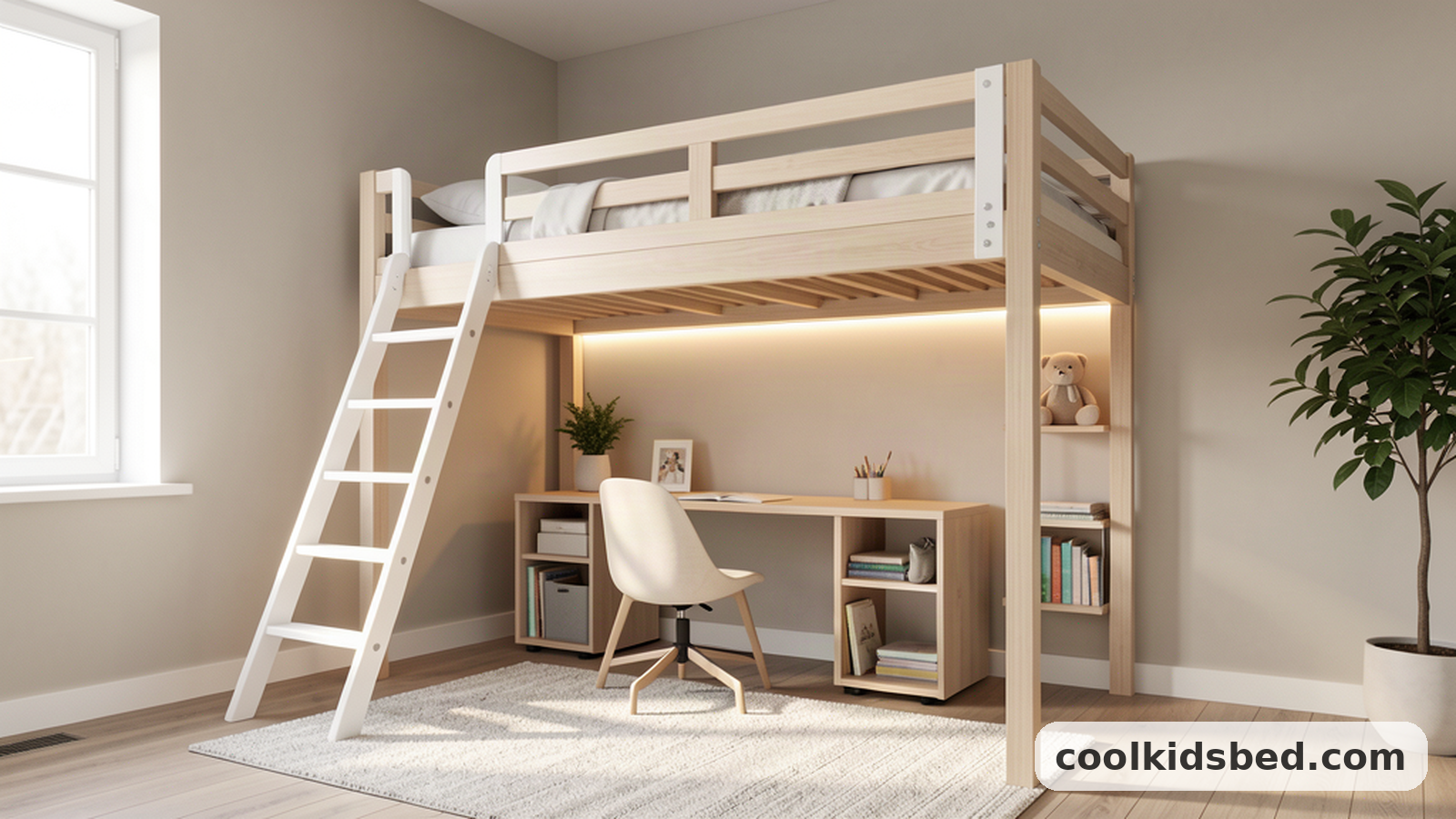
The best loft bed for an older child who needs more floor space is a high frame that clears roughly 54 inches under the platform — enough to seat a pre-teen at a desk. Height alone decides nothing: the frame has to keep that space usable.
The mistake most families make is shopping for the tallest frame they can find. Height is only half of a two-sided measurement. The other half is what sits above the mattress, because the mattress, the guardrail and the ceiling all compete for the same air. A frame that clears 54 inches underneath but leaves no room to sit up is not a better bed than a mid loft — it is a bed that makes a room feel smaller.
This guide works through the three numbers that decide the answer, compares the published clearance on the frames we sell, and covers the federal guardrail rules that apply once a child is sleeping six feet off the floor.
What changes when the child is older
A loft for a five-year-old is judged on the slide, the tent and the ladder. A loft for a ten- or twelve-year-old is judged on what happens underneath: homework, a chair that pulls out, a laptop, a shelf of books, a place to put a school bag down. That flips the priority. The lower the bed, the less useful the space beneath it, and an older child is exactly the person who needs that space to work.
The weight on the frame changes too. A twelve-year-old plus a thick mattress plus a leaning sibling is a different load case than a four-year-old plus a nap. That is why the load ratings on the frames below run from 300 lb to 600 lb on beds that photograph almost identically.
The age line in the rulebook, and the one in practice
Federal rules for children’s bunk beds treat a raised sleeping surface as unsuitable for children under six, and the warning is printed on the beds. Several of our twin lofts state “recommended age 6+” outright. In practice, the child in this article is well past that line, which means the safety question is no longer “will they fall out” but “will the guardrail still be above the mattress in three years when the mattress is replaced with a thicker one”.
The clearance ladder: low, mid and high lofts
Loft beds sold in the US cluster into three bands, and the band tells you what the space underneath is for before you read a single product photo. Low lofts are the ones where an adult has to kneel to reach the back of the space: storage boxes, a floor cushion, a play mat — not a chair. Mid lofts sit higher, but a published overall height of 40.4-inch on our twin gaming mid loft still leaves a space you sit in rather than work in.
High lofts are the band that turns floor space into a room. The three metal lofts we carry all publish the same figure, a 54.3-inch clearance from the floor to the underside — a number worth pausing on, because it is the only measurement in this article that appears on the product page rather than being calculated from a photo.
What 54 inches actually buys
A desk is about 30 inches tall and a chair seat about 18 inches, which puts a seated twelve-year-old’s head somewhere near 48 inches above the floor. At 54.3-inch clearance, that fits with room to spare, and so does a desktop plus a shelf above it. What it does not fit is a standing teenager. Desk clearance and standing clearance are different measurements, and a child who wants to walk around under the bed needs a different product rather than a taller version of this one.
The other clearance: mattress to ceiling
Here is the arithmetic that decides whether a high loft is comfortable. On a 54.3-inch-clearance frame, a 6-inch mattress on the slats puts the sleeping surface roughly 60 inches above the floor. In a room with an 8-foot ceiling that leaves about 36 inches between the mattress and the ceiling — which sits inside the 30-to-36-inch band that buying guides recommend for sitting up in bed, and at the top of it. Take six inches off the ceiling for a fan or a light fixture and the margin disappears.
Twin or full for an older child
The instinct is to move up to a full, and the measurements mostly support it — but not in the direction people expect. Compare our twin and full solid-wood loft beds with a desk, cabinet and wardrobe: both frames stand 72.2-inch tall, and width goes from a 41.3-inch twin to a 56.7-inch full. The move up does not buy extra length, because a full mattress is 75 inches long — exactly the same as a twin.
That matters in a small bedroom because walls are usually the constraint, not floor depth. A twin leaves more wall for a dresser and a door swing; a full is the right call for a teenager who reads in bed or for a room that has to serve two children eventually.
Load ratings do not follow size
Among the frames we carry, the twin solid-wood loft with an L-shaped desk and four drawers is rated 400 lb, the same frame in full is rated 600 lb, and the twin gaming mid loft is rated 350 lb. A metal full loft with a charging station and stairs is rated 350 lb, while the cheaper metal full loft with a ladder is rated 300 lb. Size predicts none of these numbers. Bracing, slat count and joint design do, and only the specification table shows them.
Five loft beds for older kids, compared on published figures
The table uses the specifications published on our own product pages. Read the clearance column before the price: two frames can look alike in a photo and leave a child with 40 inches of floor or 54.
| Model | Size | Overall L × W × H | Clearance under bed | Rated load | Mattress cap |
|---|---|---|---|---|---|
| Metal Full Size Loft Bed with Ladder and Storage Shelves | Full | 77.6″ × 56.7″ × 73.6″ | 54.3″ | 300 lb | 6″ |
| Metal Full Loft Bed with Desk, Charging Station, Stairs and Light | Full | 94.3″ × 55.8″ × 73.4″ | 54.3″ | 350 lb | 6″ |
| Metal Queen Size Loft Bed with Ladder and Storage Shelves | Queen | 82.7″ × 63″ × 73.6″ | 54.3″ | 400 lb | 6″ |
| Twin Size Solid Wood Loft Bed with Desk, Storage Cabinet and Wardrobe | Twin | 77.8″ × 41.3″ × 72.2″ | Not published (desk built in) | 400 lb | 6″ |
| Twin Gaming Mid Loft Bed with Desk and LED Light | Twin | 92.8″ × 41.7″ × 40.4″ | Not published; 40.4″ frame height | 350 lb | 6″ |
Quotable summary: the three metal lofts we carry all publish 54.3 inches of clearance under the bed, while the twin gaming mid loft stands 40.4 inches overall — the difference between a workspace and a den.
Two things fall out of that table. First, clearance is a design decision, not a price tier: the 300 lb metal loft and the 400 lb metal queen sit at the same 54.3 inches. Second, the wood frames with a desk built in do not publish a clearance figure because the desk occupies the space — you get the desk, not a choice about what goes under it. That is a fine trade if the desk is what you wanted, and a trap if you planned to put a different desk there.
The stairs-versus-ladder question also shows up in these numbers. The metal full loft with stairs runs 94.3 inches long against 77.6 inches for the ladder version, so the stair run costs roughly 17 inches of wall. Our loft bed range lists both configurations with their assembled dimensions, which is the only way to compare them honestly.
How the frames we sell compare with two Amazon options
Two listings outside our own shop are worth pricing against, because both publish the numbers that matter. The KOTEK twin loft bed with desk states 55 inches from the floor to the bed and 13-inch guardrails, with a 465 lb bed rating and a 6-inch mattress limit — a higher climb than our metal full lofts and a narrower footprint at 61 inches wide. The Harper & Bright Designs twin loft with stairs and L-shaped desk lists 93.3 by 42.4 by 65.8 inches with a 400 lb capacity, which is the same length class as our stair models at a lower overall height.
Read those the way you read ours: the clearance and the mattress cap decide whether the space works, and the load rating decides who can sleep up there in five years.
Guardrails, mattress thickness and the rules that do not bend
A raised sleeping surface more than 30 inches above the floor needs guardrails, and the child-facing standard behind that rule is 16 CFR Part 1513. The rail has to sit at least 5 inches above the mattress when the thickest mattress the manufacturer allows is in place. That single sentence explains why every frame in the table above caps the mattress at 6 inches: the cap exists to preserve the rail margin, not to sell mattresses.
Our published guardrails run 11.3 inches on the metal full loft with stairs and 13 inches on the metal ladder models. Put a 12-inch mattress on a 6-inch-limit frame and you have converted a 13-inch rail into a 7-inch one, which is still above the federal floor and well below what the frame was designed for.
Two more rules apply to older children specifically. Anchor the frame if the manufacturer supplies a strap, because a loft takes repeated sideways load every time someone climbs. And keep the ladder or stair landing clear: a bottom step behind a door swing is the most common avoidable injury in a loft bedroom.
Six measurements to take before you order
- Ceiling height at the bed’s exact spot. Sloped ceilings and ceiling fans shrink the usable height more than a wall measurement suggests.
- Floor-to-ceiling minus frame height minus mattress thickness. The result is the headroom your child actually gets; aim for 30 inches or more.
- Overall length, including the ladder or stairs. The stair version of a full loft is about 17 inches longer than its ladder twin.
- Wall width the frame will occupy. A twin needs 41.3 inches of width, a full needs 56.7, and both need a few inches for skirting boards.
- The desk and chair envelope. A 19-inch-deep desktop plus the space a chair needs behind it is the real footprint under the bed.
- Door, closet and window clearance. Egress windows have to stay reachable, and the closet door has to open past the stair run.
When a loft is the wrong answer
A high loft stops paying rent when the ceiling is under about 8 feet 6 inches, when the room has a sloped ceiling over the bed, or when the child will not use the space underneath. The last one is more common than parents expect: a desk nobody sits at is a 54-inch-tall shelf. If the plan under the bed is a beanbag and a console, a mid loft at 40 inches does the same job for less money and less climb.
If the room is short on length rather than height, a full size loft bed with stairs may be the better fit than a taller ladder model — the stair run trades length for an easier climb, which matters for a child who is up and down ten times an evening.
Frequently asked questions
How much clearance does a loft bed need to be usable for an older child?
About 54 inches from the floor to the underside is the practical target for a desk, a chair and a seated child. That is the figure three of the metal lofts we carry publish. Below roughly 40 inches the space works for storage and sitting on the floor, not for homework.
Is a loft bed safe for a 12-year-old?
Yes, provided the guardrail stays above the mattress and the frame is rated for the load. Children under 6 should not use an upper bunk at all, and the frames we sell that state an age limit say 6 and up. A 12-year-old is limited by the mattress cap and the ceiling, not by the age rule.
Can two children share a room with one loft bed?
That depends on the frame, not the concept. A full loft with a 54-inch clearance can hold a desk and a dresser underneath and leave the rest of the room as floor. A twin loft leaves about 41 inches of width against the wall, which usually leaves enough for one more twin bed if the door swing allows it.
Does a higher loft make the room feel smaller?
It can. A 73-inch frame in a room with an 8-foot ceiling leaves roughly 36 inches between the mattress and the ceiling, and less once a fan is in the way. Frame height is what you see from the doorway; headroom above the mattress is what the child feels.
What mattress thickness should I buy for a loft bed?
The cap on the frame, which is 6 inches on every model in this article’s table and 6 to 8 inches on some of our other lofts. Stay at or under it: the guardrail’s usable height shrinks by exactly the amount the mattress rises above the platform.
Bottom line
For an older child who needs real floor space, the answer is a high loft with published clearance rather than a tall loft with a marketing photo. Look for 54 inches from the floor to the underside, check that the mattress surface still leaves 30 inches or more below the ceiling, and confirm the load rating against the person who will sleep there in three years. The metal full loft with a ladder and storage shelves is the cheapest way into that clearance band, the queen version adds width and 100 lb of rating, and the wood frames with a built-in desk are the right buy if you would rather have the furniture than the empty space.