
Buying Guide
Wood Convertible Bunk Bed: The Complete Buying Guide for 2026
Oct
Wood Convertible Bunk Bed: The Complete Buying Guide for 2026
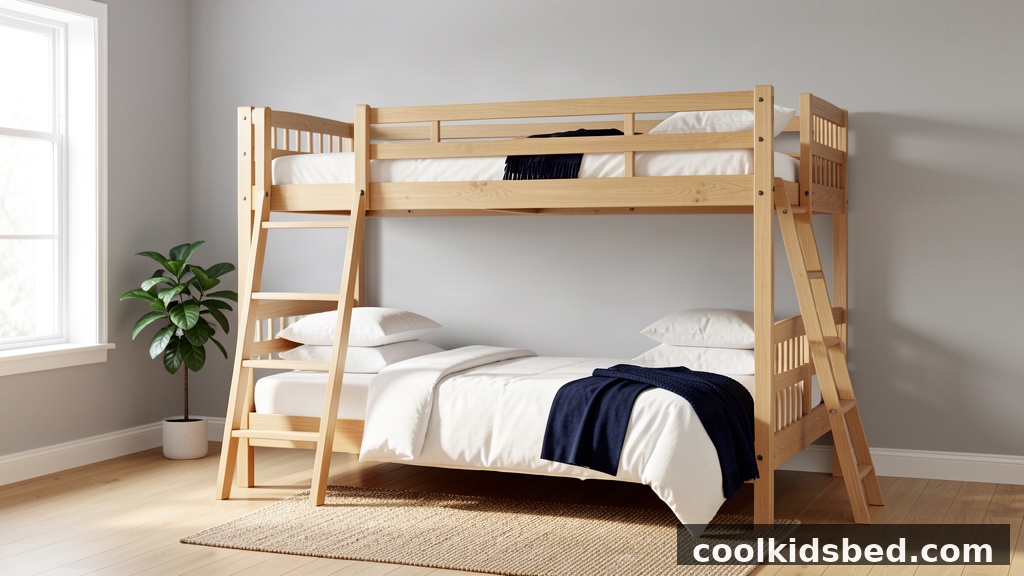
A wood convertible bunk bed is a stacked twin bed frame made from solid or engineered wood that separates into two individual twin beds. The upper and lower sections bolt together for the bunk phase and unbolt into free-standing frames later, so one purchase covers both the shared-room years and the separate rooms that follow.
Parents usually arrive at this category the same way. Two kids need to share a bedroom now, the room is too small for two beds side by side, and nobody wants to buy a second mattress set in four years when the older one starts asking for a door. A convertible frame answers that question. It behaves like an ordinary bunk while the kids are small, and when the arrangement stops working you pull eight bolts and own two twin beds instead of one obsolete piece of furniture.
That flexibility is why the category exists, and it is also where the tradeoffs hide. Convertible frames carry more hardware than fixed bunks, cost more, and are heavier to move. What follows is a breakdown of how to choose one, what the specifications mean, and which models hold up under real family use.
Why convertibility changes the math
A fixed bunk bed has one job, and it does that job until the kids stop sharing a room. Then the frame gets sold, donated, or shoved into a basement. A convertible frame gets a second life at no extra cost.
The numbers are worth running once. A mid-range wood convertible bunk runs roughly $250 to $450. Two separate comparable twin beds with frames cost about the same, but you pay for them twice over an eight-year stretch, and you pay again for the second delivery and the second assembly session. If your children are within five years of each other and the shared room is temporary, the convertible design usually comes out ahead. If the shared room is a permanent arrangement, or the bed is heading into a vacation rental that will always need four sleeping surfaces, a fixed bunk saves money up front and nothing is lost.
There is a middle case parents miss. A convertible bunk also suits a single child with frequent guests: the bunk phase handles sleepovers, and the split phase gives the kid a normal twin bed plus a spare frame for the guest room.
What separates a good wood convertible bunk from a bad one
Connecting hardware. Cheap convertible frames join the upper and lower sections with cam locks and particle board. Those joints loosen within a year of two kids climbing up and down every night. Look for metal-on-metal bolt connections, which stay tight and can be re-tightened with an Allen wrench as the frame settles.
Slat support. Plywood slats are normal at this price point and fine for kids. Solid hardwood slats are better and worth the premium if a teenager or an adult will ever sleep on either section. Every frame in this category should ship with slats included, which means no box spring and no bunkie board.
Guardrail height. The ASTM F1427 bunk bed standard requires a guardrail that leaves no more than a 5-inch gap above the mattress. That is the number to check against your mattress, not the guardrail’s own height, because a 14-inch rail on a thick mattress leaves a smaller gap than the spec sheet suggests.
Conversion access. Some frames hide the connecting bolts behind finished panels. Those take an hour and a helper. Frames that leave the bolts reachable convert in about 15 minutes with one person and a wrench. If you can find photos of the underside before buying, look at them.
Wood convertible bunk beds worth considering in 2026
Storkcraft Long Horn twin-over-twin
The Long Horn is the reference point for this category. It is built from rubberwood solids and engineered wood with a GREENGUARD Gold certification, which means it was tested for thousands of chemical emissions and cleared for indoor air quality. The stacked configuration measures roughly 64.5 inches at the side rail and about 67.5 inches at the posts, so it clears a standard 8-foot ceiling without crowding the top sleeper.
Two things make it the default recommendation. It converts into two individual twin beds by removing the hardware between the upper and lower frames, a job that takes most owners 30 to 60 minutes with basic tools. And it has a large ownership base, with thousands of reviews averaging around 4.6 stars, which is the closest thing to long-term durability data you can get on a bunk bed before you buy one.
The limitation is mattress thickness. Storkcraft specifies a low-profile mattress, typically no thicker than 7 inches, so the top sleeper stays safely below the guardrail. If you already own 10-inch mattresses, budget for replacements. Storkcraft backs the frame with a one-year limited warranty and has been building children’s furniture for more than 80 years.
Check the current price of the Storkcraft Long Horn twin-over-twin bunk bed on Amazon.
Max & Lily solid wood bunk
Max & Lily builds this frame from knot-free New Zealand pine with a non-toxic, low-VOC finish. The specification sheet is stronger than most of the category: 400 pounds per sleeping surface, 14-inch guardrails, plywood slats with a metal support bar, and metal-on-metal bolt connections. It accepts mattresses up to 8 inches thick, a little more generous than the Storkcraft.
The frame measures 81.5 inches long, 42.5 inches wide, and 65 inches tall, and Max & Lily states directly that it separates into two free-standing beds. With a 4.4-star average across more than 1,300 reviews, it is one of the better-reviewed solid pine bunks in this price band. Availability fluctuates, so check stock before you commit to it as your first choice.
Storkcraft Caribou twin-over-twin
The Caribou is the Long Horn’s sibling and the most-reviewed bed in this group, with over 6,000 ratings averaging 4.6 stars. It carries the same GREENGUARD Gold certification and the same convert-to-two-twins design. The frame is engineered wood rather than solid rubberwood, which keeps the price down and the finish polished.
Dimensions come in around 79 by 63 by 65 inches, and it ships with slats, so no box spring is needed. Storkcraft does not publish a per-bunk weight limit for this model, so if an adult will sleep on the upper section regularly, the Long Horn or a solid pine frame is the safer pick. Assembly typically runs three to four hours, and the bed may arrive in two boxes on different days.
Plank+Beam wooden bunk bed
Plank+Beam uses knot-free New Zealand pine with a hand-applied low-VOC finish, and each sleeping surface is rated for 400 pounds. The frame weighs about 124.5 pounds, which tells you how much of it is real wood. The bolt connections are noticeably more rigid than the cam-lock systems on cheaper engineered-wood bunks, which matters if your kids treat the top bunk as a trampoline.
The review base is smaller, roughly 84 ratings at 4.5 stars, so long-term evidence is thinner than Storkcraft’s. The walnut finish photographs well. This is the pick for parents who want solid wood and a low-VOC finish without spending $900.
KOMFOTT house bunk bed
KOMFOTT’s frame uses pine wood with plywood slats and a house-shaped silhouette that younger children tend to love. At about 60 inches tall it is one of the shorter bunks here, which makes it easier to place under a ceiling fan. It comes in twin-over-full as well as twin-over-twin, and it separates into two twin beds by removing the bolts that join the sections.
Assembly runs about two hours with two people. Some owners report shipping nicks on the wood, so inspect every panel before bolting and photograph any damage for a replacement request.
Jocoevol industrial convertible bunk bed
Jocoevol earns a place here because it shows what the wood frames are competing against. This is a metal bunk with rustic brown wood panels on the headboard and footboard, rated for 440 pounds on the lower bunk and 330 pounds on the upper. Guardrails measure 16.5 inches, which is taller than the ASTM minimum and gives real margin against roll-outs for restless sleepers.
More important for this discussion, the Jocoevol uses the same 2-in-1 convertible logic. It splits into two separate twin beds, and the lighter frame means one person can usually handle the conversion without a second set of hands. Clearance under the lower bunk runs about 11.2 inches, enough for standard storage bins. With 726 ratings averaging 4.4 stars, the complaint pattern is consistent: damaged parts on arrival, not structural failures.
Metal frames will not warp or absorb moisture, and the powder coat resists scratches better than painted wood. They can develop squeaks at the joints over time, which a periodic pass with an Allen wrench fixes. If you are weighing the two materials, our comparison of the best bunk bed brands for 2026 breaks down how the major manufacturers differ on construction and warranty coverage.
If you would rather not shop a roundup at all, the full bunk bed category on our site is organized by configuration.
Wood species and what the grain tells you
Rubberwood is the standard for affordable solid wood bunks. It is dense, takes a finish evenly, and comes from plantation-sourced trees, so it counts as a sustainable hardwood. Storkcraft uses it across the Long Horn and Caribou lines.
New Zealand pine has tighter grain and fewer knots than standard pine, which is why Max & Lily and Plank+Beam both use it. Plain pine is softer and dents more easily, though it sands out well.
Engineered wood costs less, weighs less, and is easier to maneuver during assembly. It also wobbles more over time and cannot be sanded back to life the way solid stock can. If the frame has to survive two active kids and a later move to a guest room, solid wood is the better bet.
Safety rules that apply to every convertible bunk
Bunk beds sold in the United States have to meet the CPSC’s bunk bed regulations, which incorporate the ASTM F1427 standard. In practice, four requirements matter to a buyer.
The upper bunk needs a guardrail on both long sides and a continuous rail on the open end. The gap between the top of the mattress and the bottom of the guardrail cannot exceed 5 inches. The openings in the frame, including the space between the ladder and the bed, have to be small enough that a child’s torso cannot pass through and their head cannot get stuck. And the upper bunk cannot be used without a properly sized mattress, which is why the manufacturer’s thickness limit is a real safety number and not a suggestion.
Parents focus on the frame and forget the accessories. Guardrails, ladders, and any add-on stairs all have their own safety considerations, and mixing parts across brands is how furniture ends up unstable. Our guide to bunk bed guard rail advice covers the gap measurement in detail, and the comparison of bunk bed ladders versus stairs explains when a sloped ladder stops being the right call for a younger child.
Measuring the room before you order
Two numbers decide whether a bunk bed fits, and neither is the bed’s length.
The first is ceiling height. Subtract 36 inches from the floor-to-ceiling measurement, which is roughly the seated headroom a teenager needs, and you have the tallest frame you can use without making the top bunk feel like a coffin. A standard 8-foot ceiling is 96 inches, so anything under 60 inches tall is comfortable for most families.
The second is the usable wall run. A twin-over-twin bunk needs about 81.5 inches of length and 42.5 inches of width once the guardrails and posts are included. A twin-over-full needs 56 inches or more of width, because the lower mattress is wider. Measure with the door swing and any closet doors in mind, since a bunk that blocks a closet is a daily annoyance for the next five years.
Leave at least 24 inches of walking space along the open side, and check that the ceiling fan is not directly over the top bunk.
Assembly and conversion, realistically
Manufacturers tend to be optimistic. A convertible twin-over-twin wood bunk has more parts than a fixed bunk, and the picture-only instruction sheets that ship with these frames are not much help.
Budget two to three hours for a two-person assembly. Metal frames run closer to 90 minutes. Sort the hardware into bowls first, and attach the top bunk with two adults, since lifting a solid wood upper section alone is how panels get cracked.
The first conversion goes faster than the original build, because you already know the frame. Expect 15 minutes for metal and 30 to 60 minutes for wood. Tape the connecting bolts to a labeled bag if there is any chance you will stack the beds again.
Mattresses and slat support
Every frame in this category ships with slats and works without a box spring, which does not make every mattress suitable.
The upper section almost always carries a thickness limit, and 7 to 8 inches is typical. A memory foam mattress measuring 10 or 12 inches pushes the sleeping surface up past the guardrail gap, which erases the safety margin the standard exists to create. Foam on slats also wants a slat gap of no more than 3 inches, so check the spacing before you commit.
If the frame will eventually serve as two separate beds, buy mattresses you are happy to keep. Two 8-inch twins work in both configurations and cost less than replacing one thick mattress later.
Making the call
Buy a wood convertible bunk bed if the shared room is temporary, if you want solid wood you can sand and refinish, or if the same frame will later serve a guest room. Buy a fixed bunk or a metal convertible frame if the room will always hold two sleepers and the budget is tighter.
Within the wood category, the Storkcraft Long Horn is the safest first look for most families, thanks to the GREENGUARD Gold certification, the solid wood construction, and the depth of its review history. Max & Lily is the pick when you want 400-pound capacity per surface and taller guardrails. Plank+Beam is the pick when the wood and the finish matter more than the size of the review base.
Whichever you choose, verify three things before the order ships: the guardrail gap against your actual mattress, the ceiling clearance over the top bunk, and whether the connecting hardware is reachable for the day you split the beds. Two related reads are our breakdown of whether convertible kids beds are worth the investment and the twin over twin bunk bed with staircase guide, which covers the case where stairs beat a ladder.